

Papal Apartments at Castel Sant’Angelo: Sala Paolina Guide
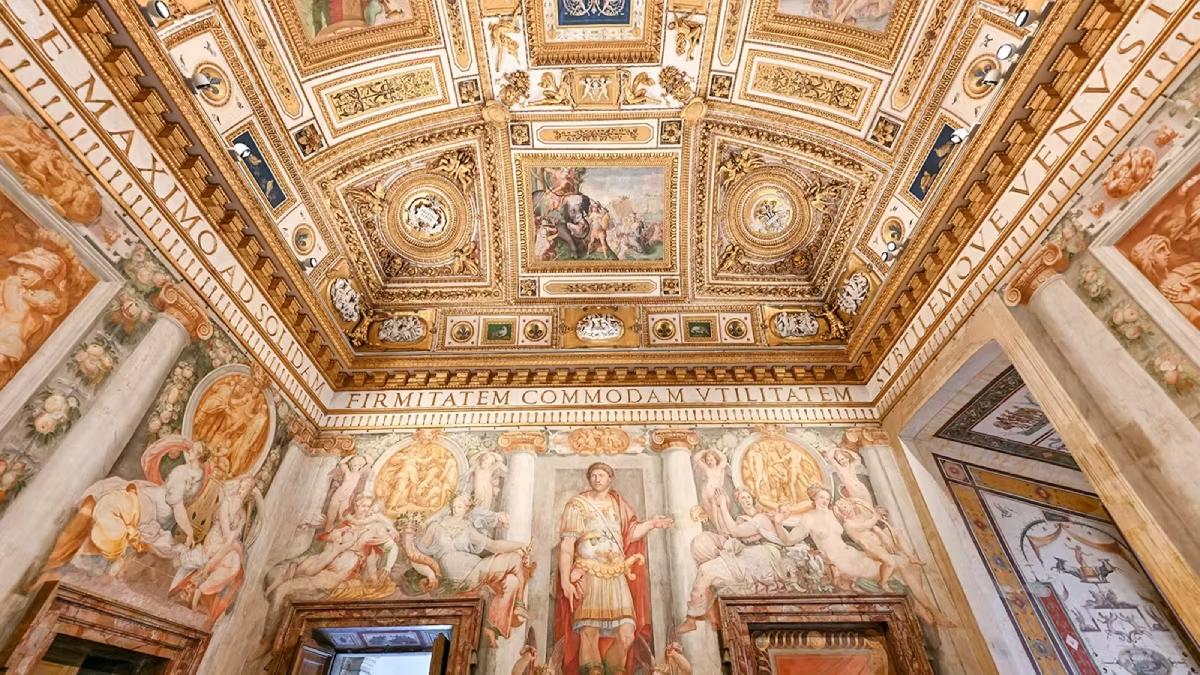
The papal apartments are the Renaissance living quarters built into the upper levels of Castel Sant’Angelo, most lavishly under Pope Paul III Farnese in the 1540s. The highlight is the Sala Paolina, a grand frescoed hall painted by Perino del Vaga and his workshop, alongside the smaller Camera di Amore e Psiche and Camera del Perseo, whose ceiling friezes give them their names. The rooms mix courtly luxury with a fortress’s practicality — a reminder that popes lived here as a refuge, not just a palace.
Climb past the courtyards and armory and you reach a different castle entirely: rooms painted floor to ceiling with mythology, papal propaganda, and trompe-l’oeil architecture that popes commissioned while the walls around them still had to withstand a siege. These apartments were where Renaissance popes actually lived when Rome turned dangerous.
This guide walks through the Sala Paolina, the Camera di Amore e Psiche, the Camera del Perseo, and the loggias, explaining who painted them, what the scenes mean, and why a fortress ended up with some of Rome’s finest 16th-century decoration.
A Fortress Built for Papal Refuge
The papal apartments exist because popes needed somewhere safe to live when Rome was threatened. Medieval and Renaissance popes had already fortified the old mausoleum, and the Farnese-era decoration turned part of it into a residence fit for a Renaissance court without giving up its defensive purpose.
By the time Paul III commissioned his apartments in the 1540s, the building had been a papal stronghold for centuries, connected to the Vatican by the fortified Passetto di Borgo escape corridor. The apartments sit within that same defensive shell — thick walls, small windows, a single controlled route up from the courtyards below. What changed was the interior: instead of bare fortress rooms, popes wanted spaces that projected authority and taste to cardinals, ambassadors, and visiting dignitaries who had to be received somewhere grander than a garrison. The result is one of Rome’s more striking contrasts — walk through a room decorated with gilded stucco and mythological frescoes, then step onto a rampart designed to repel cannon fire.
The Sala Paolina
The Sala Paolina is the largest and most important room in the papal apartments, commissioned by Pope Paul III Farnese and frescoed mainly by Perino del Vaga and his workshop in the early 1540s. Its walls combine trompe-l’oeil architecture with scenes celebrating Alexander the Great and Saint Paul, chosen because “Paul” linked the pope’s own name to both figures.
The Sala Paolina (Pauline Hall) is the room most visitors remember. It’s a large reception hall with a painted architecture of false niches, columns, and statues that trick the eye into reading a flat wall as three-dimensional space — a technique Renaissance decorators used to make modest rooms feel monumental. Real doors and painted ones sit side by side, and it takes a moment standing in the room to tell which is which.
The fresco program was directed by Perino del Vaga, a former assistant of Raphael, working with a team of collaborators through the early 1540s. The subject matter is deliberately chosen to flatter Paul III: scenes drawn from the life of Alexander the Great sit alongside episodes from the life of Saint Paul, playing on the shared name — the pope was born Alessandro Farnese, so “Alexander” and “Paolo” (Paul) both point back to him. Look for the fresco of the Archangel Michael, the figure the whole castle is named for, and for the painted false door on one wall that mirrors the room’s real doorway with almost perfect symmetry. The ceiling carries the Farnese coat of arms and further mythological and allegorical figures, tying the whole room together as a statement of papal and family prestige.
Camera di Amore e Psiche
The Camera di Amore e Psiche (Room of Cupid and Psyche) takes its name from the frieze running around the top of its walls, illustrating the mythological love story of Cupid and Psyche. It’s a smaller, more intimate space than the Sala Paolina — closer to a private sitting room than a reception hall — and its decoration leans into courtly romance rather than political messaging. The frieze is easy to miss if you’re only looking straight ahead, so glance up as you pass through.
Camera del Perseo
Next to it, the Camera del Perseo (Room of Perseus) is named for its own painted frieze, depicting scenes from the myth of Perseus. Like the Amore e Psiche room, it forms part of the private, more domestic wing of the apartments, distinct from the ceremonial grandeur of the Sala Paolina next door. Together the two rooms give a sense of how the Farnese-era popes actually lived day to day, surrounded by mythological scenes chosen as much for their visual appeal as any deeper program.
The Loggias of Julius II and Paul III
The apartments include two open loggias — one built for Pope Julius II, one for Paul III — that break the fortress’s defensive walls with arched openings framing views over the Tiber and toward the Vatican. They were built for comfort and prestige at a time when the castle’s military role still shaped everything around them.
Two loggias punctuate the apartments: one commissioned by Julius II in the early 1500s, the other added later under Paul III. Both open onto the river side of the castle with arched, colonnaded views over the Tiber toward St. Peter’s and the Vatican — a striking contrast to the narrow defensive slits found elsewhere in the building. Popes used these loggias to take in air and light in a fortress that otherwise offered little of either, and the views they frame are some of the best reasons to slow down on this level of the visit rather than hurrying straight to the terrace above.
Farnese Luxury Inside a Working Fortress
The papal apartments only make sense in context: this decoration was applied to a building that had been, and remained, a working military stronghold. Cannons, garrisons, and prison cells occupied other parts of the same structure while Perino del Vaga’s team gilded ceilings and painted mythological friezes a few rooms away. Paul III’s building campaign reflects a broader Renaissance pattern — popes and princes softening fortified residences with courtly decoration without ever fully giving up their defensive function, because the political dangers that had built the fortress hadn’t gone away. That tension between luxury and refuge is part of what makes the rooms worth lingering in rather than treating as a quick corridor between the courtyards and the terrace.
Who to Look For: The Artists
Perino del Vaga is the name most associated with the papal apartments. Trained under Raphael and active on major Roman commissions after Raphael’s death, he directed the Sala Paolina’s fresco program with a workshop of collaborators through the early 1540s, blending trompe-l’oeil illusion with the narrative scenes of Alexander and Saint Paul. The friezes in the Camera di Amore e Psiche and Camera del Perseo reflect the same Farnese-era decorative campaign, produced by artists working in a similar style even where individual attributions are less firmly documented than in the Sala Paolina itself. If you’re interested in the wider building history that set the stage for this decoration, our guide to Castel Sant’Angelo’s history covers how the mausoleum became a papal fortress in the first place.
What to Look For on Your Visit
- The trompe-l’oeil architecture in the Sala Paolina — spot the real door against the painted one.
- The Alexander the Great and Saint Paul fresco cycles, and the wordplay on Paul III’s birth name.
- The Archangel Michael fresco, echoing the statue that crowns the castle’s rooftop.
- The friezes above the walls in the Camera di Amore e Psiche and Camera del Perseo.
- The Farnese coat of arms worked into the ceiling decoration.
- The views from the loggias of Julius II and Paul III toward the Tiber and the Vatican.
These rooms sit partway through the climb described in our floor-by-floor walkthrough, between the Renaissance courtyards below and the Terrace of the Angel above, so budget time here rather than treating it as a pass-through on the way to the view.
Frequently Asked Questions
What are the papal apartments at Castel Sant’Angelo?
They’re the Renaissance living quarters built into the upper levels of the castle, decorated mainly under Pope Paul III Farnese in the 1540s. They include the Sala Paolina, the Camera di Amore e Psiche, the Camera del Perseo, and two loggias, all set within a building that remained a functioning fortress.
Who painted the Sala Paolina?
The fresco program was directed by Perino del Vaga, a former assistant of Raphael, working with a team of collaborators in the early 1540s. The scenes celebrate Alexander the Great and Saint Paul, both linked to Paul III’s birth name, Alessandro Farnese.
Why is it called the Sala Paolina?
It’s named for Pope Paul III (Paolo III), who commissioned the room. The decoration deliberately plays on his name, pairing scenes from the life of Alexander the Great with scenes from the life of Saint Paul.
What is the Camera di Amore e Psiche?
It’s a smaller room in the papal apartments named for the frieze around its walls, which depicts the mythological love story of Cupid and Psyche. It sits alongside the similarly named Camera del Perseo in the more private wing of the apartments.
What is the Camera del Perseo?
The Camera del Perseo is a room decorated with a frieze illustrating the myth of Perseus. Like the Camera di Amore e Psiche next to it, it formed part of the pope’s private quarters rather than the ceremonial reception spaces.
What are the loggias of Julius II and Paul III?
They’re two open, arched galleries built into the papal apartments, one under Pope Julius II and one under Paul III, offering views over the Tiber toward the Vatican. They were built for light and comfort in a section of the castle otherwise dominated by defensive architecture.
Are the papal apartments included in the standard entry ticket?
Yes. The papal apartments are part of the standard museum route through Castel Sant’Angelo, included with regular admission rather than requiring a separate ticket.
How long should I spend in the papal apartments?
Most visitors spend 15 to 25 minutes moving through the Sala Paolina and the adjoining rooms, longer if you want to study the frescoes closely. Our guide to how long to spend at the castle covers timing for a full visit.
Why does a fortress have such elaborate decoration?
Because Renaissance popes needed the castle as both a working stronghold and a residence fit for a papal court. Paul III’s decoration added courtly luxury to rooms that still sat within the same defensive walls used for refuge during crises like the 1527 Sack of Rome.
Where are the papal apartments located inside the castle?
They occupy the upper levels of the castle, reached after the Renaissance courtyards and before the final climb to the rooftop Terrace of the Angel. They sit roughly in the middle of the five-level visit.
