

Roma Pass 2026: Is Castel Sant’Angelo Included & Worth It?
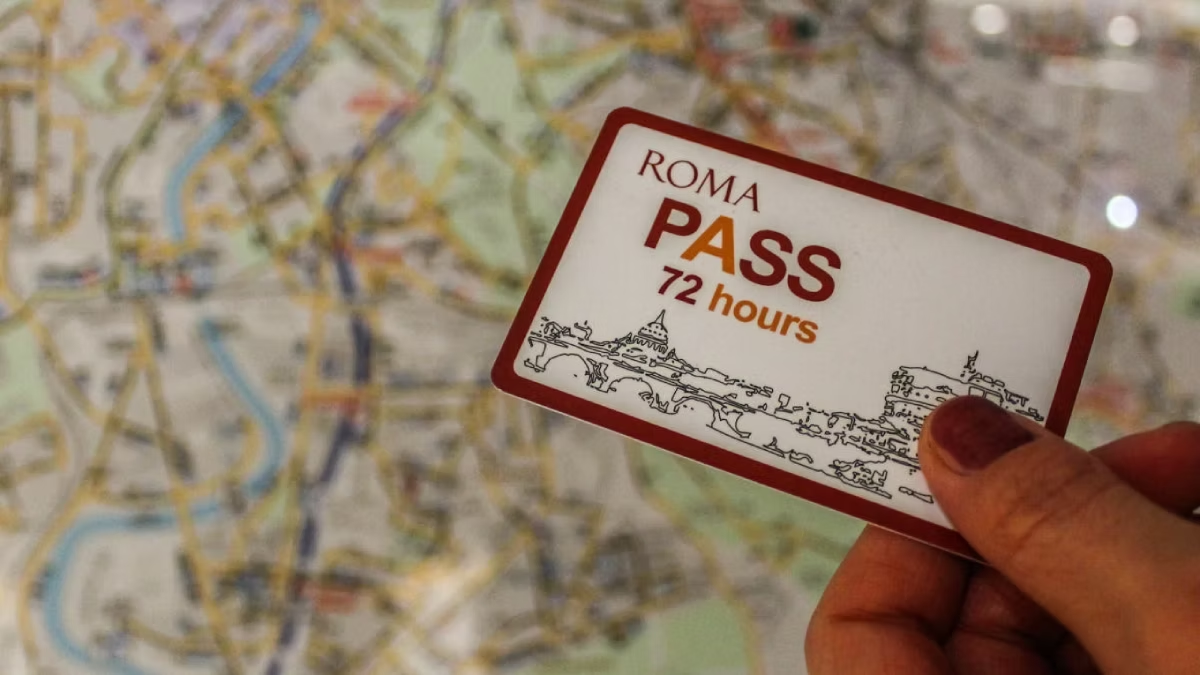
Yes — Castel Sant’Angelo is one of the state-run sites covered by the Roma Pass, so it can be one of your free entries (48-hour pass) or one of your two free entries (72-hour pass), with unlimited public transport included either way. But the pass is not automatically a bargain for a castle-focused trip: run the numbers below before you buy, especially if you’d otherwise visit on the first Sunday of the month, when the castle is free anyway.
The Roma Pass is Rome’s official city card, and it bundles free museum entries, unlimited public transport, and discounts into one purchase. Castel Sant’Angelo is on its list of participating sites, which raises the obvious question for anyone planning a castle-focused visit: does it actually make sense to buy the pass just to see the castle, or is a direct entry ticket the smarter move? This guide explains what the Roma Pass covers, exactly how it applies to Castel Sant’Angelo, and does the math so you can decide.
What the Roma Pass Actually Is
The Roma Pass is a city card sold in two durations — 48 hours (about €38) and 72 hours (about €62.90) — that gives you unlimited use of Rome’s public transport network, one free entry (48-hour) or two free entries (72-hour) to participating museums and archaeological sites, and discounted admission to everything else on its list, plus discounts on some tours and events.
The pass activates the moment you use it for the first time, whether that’s tapping onto a bus or redeeming your first free entry, and it runs continuously from there — a 48-hour pass bought at 3 PM on a Tuesday expires at 3 PM on Thursday. It covers Rome’s metro, tram, bus, and ATAC urban rail lines, and it comes as a digital pass redeemed through a smartphone app rather than a physical card, so you’ll need a charged phone with the app downloaded. It is non-refundable and non-transferable once activated.
The free-entry allowance is the heart of the pass: on the 48-hour version you pick one site for a free visit, and on the 72-hour version you pick two. Every other participating site on your itinerary is discounted rather than free. Two of Rome’s biggest draws — the Colosseum/Roman Forum/Palatine Hill and the Borghese Gallery — require a mandatory advance reservation even with the pass, so if either is on your list, book that slot well ahead (10 days out, 20 in peak season, is the general guidance).
Is Castel Sant’Angelo Included in the Roma Pass?
Yes. Castel Sant’Angelo is a state-run museum and appears among the more than 45 attractions the Roma Pass covers, alongside sites like the Colosseum, Roman Forum, Palatine Hill, the Capitoline Museums, and the Baths of Caracalla. That means you can use one of your pass’s free entries here, or visit at a discount if you’ve already spent your free entries elsewhere.
There’s no separate “Castel Sant’Angelo pass” and no trick to it — the castle is simply one line on the Roma Pass’s list of participating museums and archaeological sites, on the same footing as the other national and municipal collections in Rome. If you assign one of your free entries to Castel Sant’Angelo, you show up, redeem it through the app (or at the ticket desk, depending on how the site handles Roma Pass visitors that season), and go in exactly as any other visitor would, with the same route through the papal apartments and up to the Terrace of the Angel.
One practical caveat: unlike the Colosseum and Borghese Gallery, Castel Sant’Angelo isn’t flagged as requiring a mandatory advance reservation on the Roma Pass itself. But the castle runs on timed entry for its own ticketing, and in peak season the ticket-office line to redeem a Roma Pass voucher can be just as long as the line for a regular ticket. If you want a guaranteed, no-queue arrival, it’s worth checking whether you can reserve your Roma Pass entry time for the castle online before you go, rather than assuming you can simply walk up and swap the pass for a ticket.
Using the Pass Here: Timed Entry and the Free First Sunday
Castel Sant’Angelo’s own timed-entry system still applies to Roma Pass visitors, so plan your arrival window the way you would for any ticket. And because the castle is free for everyone on the first Sunday of each month regardless of the Roma Pass, that’s the one day you should not “spend” a Roma Pass free entry here — save it for a site that isn’t already free that day.
If your Rome dates happen to land on the first Sunday of the month, this is the detail that saves you money: Castel Sant’Angelo, like other Italian state museums, opens free to all visitors on that day under the national scheme. A Roma Pass free entry used here on a free Sunday is a wasted entry, since you’d have gotten in for nothing anyway. Redirect that free entry to the Colosseum, the Borghese Gallery, or another paid site instead, and simply walk into the castle using the free Sunday. The trade-off is that free Sundays are busier than normal, so arrive close to the 9:00 AM opening if you go this route.
Outside of a free Sunday, book your Castel Sant’Angelo time slot the same way you’d plan any best time to visit: mid-morning and midday get busiest, and the hour or so before the 6:30 PM last admission tends to be calmest.
Is the Roma Pass Worth It for a Castle-Focused Trip?
Usually not, if Castel Sant’Angelo is the main reason you’re buying it. A direct entry ticket runs around €16, well under the cost of even the 48-hour pass, and the pass only starts to pencil out once you add in real public-transport use and at least one or two other paid attractions on top of the castle. For a visit built mostly around the castle and a walk across the river, a single ticket is the cheaper, simpler choice.
Here’s the honest math. A standard Castel Sant’Angelo entry ticket costs about €16. The 48-hour Roma Pass costs about €38 and includes one free entry plus unlimited transport; the 72-hour pass costs about €62.90 and includes two free entries plus unlimited transport. If Castel Sant’Angelo is your only free-entry redemption and you take a handful of Metro or bus rides over the two days, you’re looking at roughly €16 of museum value plus perhaps €10–15 of realistic transport use — somewhere in the low-to-mid €20s of value against a €38 outlay. On that math alone, the pass loses to simply buying a direct ticket and paying for transit as you go.
The pass starts to make sense only when it’s doing more work than covering one museum. If your Rome days also include the Colosseum/Forum/Palatine (a paid combo ticket in its own right), the Borghese Gallery, or another major paid site — and you’re genuinely riding public transport several times a day — the free entries and discounts can add up to more than the pass price. In other words: buy the Roma Pass because you’re doing a broad, multi-site, transit-heavy Rome itinerary that happens to include Castel Sant’Angelo, not because you specifically want to see the castle. For a trip where the castle is the centerpiece, a direct entry ticket — or a ticket paired with one or two other sights — is the better value, and our which ticket to buy guide compares that decision in more detail.
What is included: A Roma Pass valid for 48 or 72 hours, giving unlimited use of Rome’s metro, tram, bus, and ATAC urban rail network; free admission to 1 (48-hour) or 2 (72-hour) participating museums or sites of your choice, including Castel Sant’Angelo; discounted admission to 45+ other participating attractions; discounts on selected tours, exhibitions, and events; and unlimited access to P.Stop public restrooms. Delivered as a digital pass through a smartphone app.
Duration: Choose 48 hours or 72 hours at checkout; the pass activates on first use and runs continuously from that moment
Cancellation: Non-refundable and non-transferable once purchased and activated — confirm your dates before buying
Best for: Travelers doing a broad, multi-site Rome itinerary with heavy public-transport use, where Castel Sant’Angelo is one stop among several paid attractions rather than the main event
Buy This TicketRoma Pass vs a Direct Castel Sant’Angelo Ticket
If you already know your Rome trip revolves around the castle, the Vatican area, and maybe one or two nearby sights, skip the pass math and just compare tickets directly. A standalone entry ticket is cheaper, gets you a guaranteed timed slot without the pass’s redemption question mark, and doesn’t require you to plan a wider multi-site itinerary to get your money’s worth. If instead you want an expert leading the visit, a guided tour is a separate purchase and isn’t covered or discounted by the Roma Pass at Castel Sant’Angelo. The Roma Pass earns its price only when it’s replacing several separate purchases — transit tickets plus two or three attraction tickets — not when it’s replacing one.
Frequently Asked Questions
Is Castel Sant’Angelo included in the Roma Pass?
Yes. Castel Sant’Angelo is one of the more than 45 participating museums and archaeological sites on the Roma Pass, so you can use one of your pass’s free entries here or visit at a discounted rate if you’ve already used your free entries elsewhere.
Does the Roma Pass give free entry or just a discount at Castel Sant’Angelo?
It depends on how you allocate your pass. The 48-hour pass includes one free entry to a site of your choice and the 72-hour pass includes two; if you assign one of those free entries to Castel Sant’Angelo, admission is free, otherwise it’s discounted like the pass’s other participating sites.
Do I still need a timed-entry slot for Castel Sant’Angelo with the Roma Pass?
Yes. The castle’s own timed-entry system still applies, and unlike the Colosseum and Borghese Gallery, Castel Sant’Angelo isn’t listed as requiring a mandatory advance reservation on the pass. Check whether you can reserve a specific time slot online when redeeming your pass, since the on-the-day redemption line can be as long as the regular ticket line in peak season.
Should I use my Roma Pass free entry on Castel Sant’Angelo?
Only if you’re not visiting on the first Sunday of the month, when the castle is already free for everyone. If your dates include a free Sunday, save your Roma Pass free entry for a paid site like the Colosseum or Borghese Gallery instead, and visit the castle on the free day.
Is the Roma Pass worth it just to see Castel Sant’Angelo?
Usually not. A direct entry ticket costs around €16, which is less than even the 48-hour Roma Pass at about €38. The pass only becomes good value once you’re also visiting other paid attractions and making real use of the included public transport.
What’s the difference between the 48-hour and 72-hour Roma Pass?
The 48-hour pass costs about €38 and includes one free museum or site entry; the 72-hour pass costs about €62.90 and includes two. Both include unlimited public transport and discounted admission to the pass’s other participating attractions for the full validity window.
Does the Roma Pass cover public transportation in Rome?
Yes. It gives unlimited use of Rome’s metro, tram, bus, and ATAC urban rail network for the full 48 or 72 hours, which is one of the pass’s clearest sources of value if you’re moving around the city a lot.
Is the Roma Pass refundable if my plans change?
No. The Roma Pass is non-refundable and non-transferable once purchased, so confirm your travel dates and the sites you plan to visit before buying.
What other sites can I pair with Castel Sant’Angelo on a Roma Pass itinerary?
The pass covers major sites like the Colosseum, Roman Forum, Palatine Hill, the Borghese Gallery, the Capitoline Museums, and the Baths of Caracalla, among 45+ attractions in total. Since the Colosseum and Borghese Gallery require mandatory advance reservations, book those slots first if you want them included.
How do I redeem the Roma Pass at Castel Sant’Angelo?
The Roma Pass is a digital pass managed through a smartphone app, so you’ll need a charged phone with the app downloaded to redeem your free entry or discount at the castle. Confirm the current redemption process on the official booking page before your visit, since procedures at individual sites can change.
