

Hadrian’s Mausoleum: The Ancient Roots of Castel Sant’Angelo
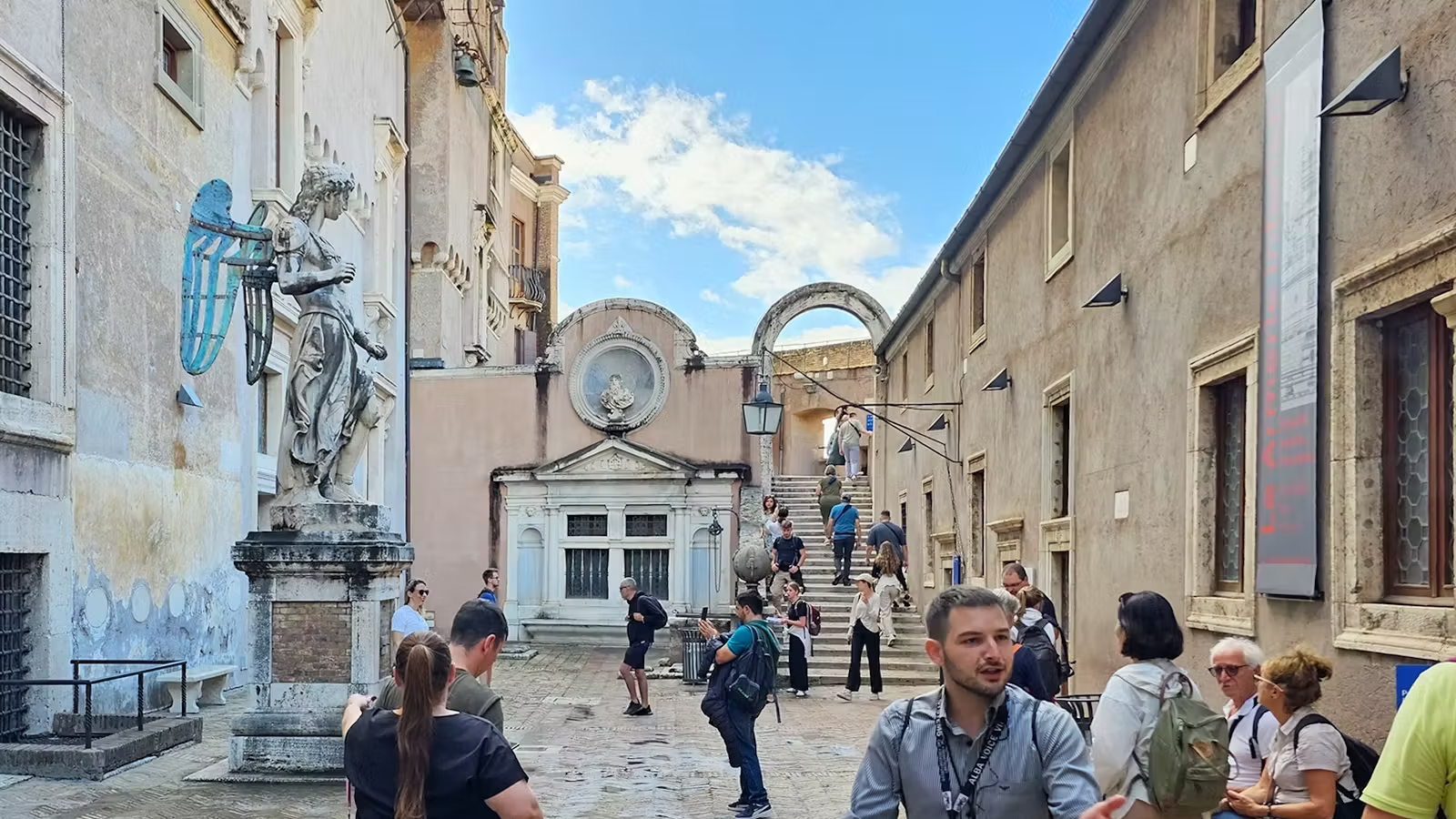
Castel Sant’Angelo began life as the Mausoleum of Hadrian, a monumental tomb the emperor commissioned for himself and his successors, completed in AD 139 under Antoninus Pius. Ancient emperors from Hadrian to Caracalla were entombed inside; the original cylindrical drum, a spiraling ramp, and traces of the marble facing and vestibule survive within the later fortress you visit today.
Almost 1,900 years before it became a papal fortress and a museum, this riverside monument was Imperial Rome’s grandest tomb. Emperor Hadrian planned it as his own mausoleum and that of his dynasty, and what visitors climb today — courtyards, ramparts, the winding upper passages — sits directly on top of that original Roman structure.
Understanding the ancient core changes how you experience the visit. The famous helical ramp you walk near the entrance is not a medieval or Renaissance addition; it is close to 1,900 years old, built for Hadrian’s own funeral procession. This guide covers the mausoleum’s design, who was buried there, how it was stripped and fortified over the centuries, and exactly what ancient fabric you can still see on a visit.
Hadrian’s Mausoleum: Origins and Purpose
Emperor Hadrian commissioned the mausoleum to replace the Mausoleum of Augustus, which had run out of space, as the new dynastic tomb for himself and future emperors. Construction began around AD 135, on the right bank of the Tiber outside the city center, and the building was completed in AD 139 under his successor, Antoninus Pius, a year after Hadrian’s death.
Hadrian, who ruled Rome from AD 117 to 138, was a builder-emperor known for the Pantheon’s dome and his villa at Tivoli, and he wanted a burial monument to match. By his reign, the old Mausoleum of Augustus across the river had been full for over a century, so Hadrian chose a new site on the far bank, connected to the city by a purpose-built bridge — the structure now known as Ponte Sant’Angelo. Work began around AD 135, but Hadrian died in AD 138 before it was finished. His successor, Antoninus Pius, completed the mausoleum and formally dedicated it in AD 139, placing Hadrian’s ashes inside along with those of his wife, Sabina, and his adopted son Lucius Aelius, who had died before him.
The mausoleum was never a private family monument alone; it was conceived as the resting place of the ruling dynasty, a deliberate statement of imperial permanence on a grand scale near the heart of the empire.
The Original Design: Drum, Garden, and Bronze Quadriga
The mausoleum was built as a massive cylindrical drum of concrete faced in travertine and marble, set on a square base, with a central burial chamber reached by a spiral ramp. Its summit carried a mound planted with cypress trees and was crowned by a colossal bronze statue of Hadrian riding a four-horse chariot, or quadriga.
The base was a square platform roughly 89 meters (around 290 feet) on each side, faced in marble and likely decorated with sculpted friezes and inscriptions naming the emperors interred within. Rising from it was the drum itself: a cylinder about 64 meters (210 feet) in diameter, built from Roman concrete and brick, then clad in gleaming white travertine and marble. At its center, reached by the helical ramp, sat a small square burial chamber holding urns with the ashes of Hadrian and his successors.
Above the drum, ancient sources and archaeological study suggest a landscaped mound planted with cypress trees, echoing the garden crown of the older Mausoleum of Augustus. At the very top stood the monument’s most theatrical feature: a colossal bronze statue of Hadrian driving a quadriga, a four-horse chariot, visible for a considerable distance along the river and from the city itself. Nothing of the statue survives, but its memory shaped later legend — some accounts link the loss of its bronze to the building’s long history of being stripped for material.
Who Was Buried in the Mausoleum
The mausoleum held the ashes of Hadrian and his immediate family, then continued as the imperial tomb for his adopted successor Antoninus Pius, Marcus Aurelius and his family, and later emperors down to Caracalla in the early third century AD.
Hadrian himself was the first emperor interred, alongside his wife Sabina and Lucius Aelius. Antoninus Pius, who completed the building, was buried there in AD 161, followed by members of his family. The tomb then received Marcus Aurelius, the philosopher-emperor, in AD 180, along with his wife Faustina the Younger and other relatives. Burials continued through the Severan dynasty, with the last recorded imperial interment being Caracalla in AD 217, roughly eighty years after the mausoleum’s completion. After Caracalla, no further emperors are documented as having been buried there, and the tomb’s original funerary function effectively ended, even though the structure itself endured for many more centuries.
The Helical Ramp
The helical, or spiral, ramp is the mausoleum’s original access route to the central burial chamber, cut into the base of the drum and rising in a continuous curve rather than stairs. Visitors today still walk this same ancient passage near the start of the visit, one of the best-preserved pieces of Roman engineering inside the castle.
The ramp was designed to carry funeral processions — and later, visitors and materials — up through the mass of the drum without steps, using a gently graded spiral instead. It was built with a barrel-vaulted ceiling and originally lined with fine marble, some of which survives in fragments and in the paving underfoot. Torch niches and light wells punctuate the walls, hinting at how the passage was illuminated in antiquity. Today the ramp remains one of the most atmospheric parts of any visit: cool, dim, and unmistakably ancient, it deposits visitors near the level of the original burial chamber before the route continues up through the later fortress and papal additions. It is a physical climb, so allow a few minutes and expect a gentle but continuous incline; anyone with mobility concerns should check our guide to accessibility before visiting.
The Dromos and Vestibule
Before reaching the helical ramp itself, ancient visitors and funeral processions passed through a dromos — a straight entrance corridor — leading into a vestibule at the base of the drum. This vestibule likely once held a statue or inscription identifying the tomb and its occupants, marking the formal transition from the outside world into the sacred, closed space of the mausoleum. Portions of this approach survive within the castle’s lower levels and are incorporated into the modern visitor route, giving a sense of how deliberately the ancient builders staged the experience of entering an imperial tomb.
From Tomb to Fortress: Stripping and Spolia
After its use as an imperial tomb ended in the third century AD, the mausoleum was steadily converted into a military stronghold, incorporated into the Aurelian Walls around AD 271 and later stripped of its marble facing and statuary. Much of that material was reused, or “spolia,” in other Roman buildings, including nearby churches and fortifications.
The mausoleum’s transformation began not long after its funerary role ended. In AD 271, Emperor Aurelian incorporated the massive drum into Rome’s new defensive walls, recognizing its strategic value on the river crossing guarding the approach from the north. Over the following centuries, as the western empire declined and Rome’s population and resources shrank, the once-pristine marble cladding, statues, and decorative elements were gradually removed. Some of this material was burned for lime, some was repurposed directly as spolia — recycled stone and columns — in medieval churches and other buildings around the city, a common fate for Roman monuments once their original purpose faded. According to tradition, even some of the bronze urns holding imperial ashes were lost or scattered during the sieges and sackings the building endured, including the Gothic siege of Rome in AD 537, when defenders reportedly hurled statuary down on attackers below.
By the early Middle Ages, the elegant marble drum had become a bare, battered core, valued now purely for its defensive mass rather than its original grandeur — the starting point for its long second life as a papal fortress and prison, and eventually today’s museum.
Ancient Remains You Can Still See Today
Despite roughly nineteen centuries of stripping, sieges, and rebuilding, a surprising amount of the original Roman structure survives, and much of it is visible on a standard visit:
- The helical ramp — the best-preserved ancient element, still walked by every visitor near the start of the route, with original vaulting and traces of marble paving.
- The core of the cylindrical drum — the massive concrete-and-brick mass at the heart of the building, still forming the structural base for everything built above it in later centuries.
- The dromos and vestibule — the ancient entrance sequence, partly incorporated into the modern approach.
- Remnants of the burial chamber — the small central room near the top of the ramp, where the imperial urns were originally housed, though its decoration is long gone.
- Fragments of marble facing and inscriptions — scattered pieces, some displayed within the castle’s museum rooms, hinting at the original opulence of the exterior.
For a full sense of how these ancient elements connect to the Renaissance courtyards, papal apartments, and rooftop terrace built above them, our floor-by-floor walkthrough of the interior is the natural next stop.
Frequently Asked Questions
When was Hadrian’s Mausoleum built?
Construction began around AD 135 under Emperor Hadrian and was completed in AD 139, a year after his death, by his successor Antoninus Pius. It served as the tomb of Hadrian and later Roman emperors for roughly eighty years.
Who is buried in Castel Sant’Angelo?
The mausoleum originally held the ashes of Hadrian, his wife Sabina, and successive emperors including Antoninus Pius, Marcus Aurelius, and members of their families. The last recorded imperial burial was Caracalla in AD 217; none of the original urns or remains survive on site today.
What was the mausoleum originally shaped like?
It was built as a large cylindrical drum on a square marble-faced base, topped with a mound of cypress trees and a colossal bronze statue of Hadrian driving a four-horse chariot. The overall design deliberately echoed the earlier Mausoleum of Augustus across the river.
Is the helical ramp the original Roman one?
Yes. The spiral ramp near the start of the visit is the mausoleum’s original ancient access route to the burial chamber, built to carry funeral processions up through the drum without stairs. It still has its Roman vaulting and is one of the best-preserved parts of the entire complex.
What happened to the bronze statue on top of the mausoleum?
No trace of the original bronze quadriga survives; it was likely melted down or lost during the centuries when the building was stripped of its valuable materials. The statue most visitors associate with the castle today, the bronze Archangel Michael, dates from the eighteenth century and stands on a different part of the structure.
Why was the tomb turned into a fortress?
Its massive, solid drum made it an ideal defensive stronghold on the river approach to Rome, and Emperor Aurelian incorporated it into the city’s defensive walls around AD 271. As imperial burials ended and Rome’s fortunes declined, the building’s military value outlasted its funerary purpose.
Can you still see ancient Roman parts of Castel Sant’Angelo today?
Yes. The helical ramp, the core of the cylindrical drum, portions of the entrance dromos and vestibule, and scattered marble fragments all survive from the original mausoleum and are visible on a standard visit. They sit beneath and alongside the later Renaissance and papal additions.
What does “spolia” mean in relation to the mausoleum?
Spolia refers to building material stripped from an older monument and reused elsewhere. Much of the mausoleum’s marble facing, columns, and decorative stone were removed over the centuries and reused in other Roman buildings, including churches, which is part of why so little of the original exterior survives.
How is Hadrian’s Mausoleum connected to Ponte Sant’Angelo?
Hadrian built the bridge, originally called Pons Aelius, specifically to connect his new mausoleum to the city center across the Tiber. The bridge still stands today, now known as Ponte Sant’Angelo and lined with Baroque angel statues, and remains the traditional approach to the castle on foot.
Do I need a special ticket to see the ancient parts?
No. The helical ramp and other surviving ancient elements are included in the standard Castel Sant’Angelo entry ticket and form part of the normal visitor route near the beginning of the visit. No separate booking is required to see them.
