

Ponte Sant’Angelo: Bernini’s Angels, History & Best Photos
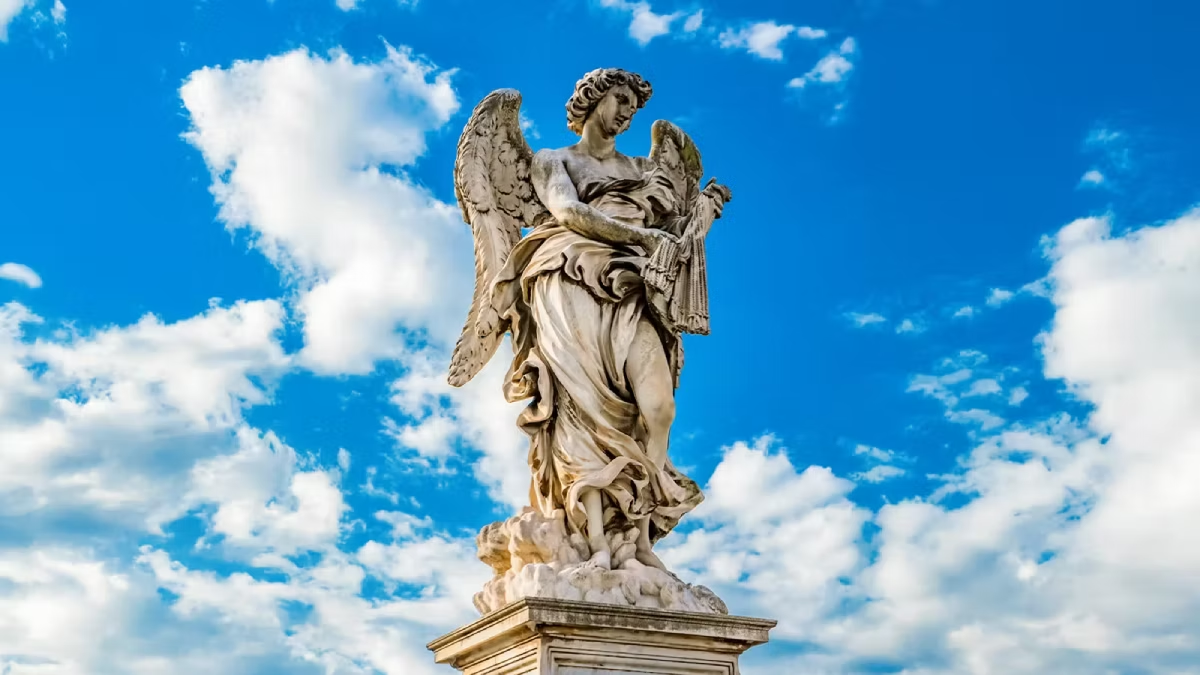
Ponte Sant’Angelo is the pedestrian bridge over the Tiber that leads straight to Castel Sant’Angelo, built by Emperor Hadrian in AD 134 and later lined with ten Baroque angel statues designed under Gian Lorenzo Bernini. It’s free, has no gates or opening hours, and is one of the best spots in Rome for a photo of the castle. Come at sunrise or sunset for the softest light and thinnest crowds.
Long before you reach the ticket line at Castel Sant’Angelo, you’ll likely cross Ponte Sant’Angelo, and it’s worth slowing down when you do. This isn’t just a way to get from the historic center to the castle — it’s one of Rome’s oldest river crossings, still resting in part on 2,000-year-old Roman piers, and it doubles as an open-air gallery of ten wind-blown angel statues that Bernini designed to carry visitors’ eyes straight toward the mausoleum-turned-fortress on the far bank.
This guide covers where the bridge came from, what each angel is holding and why two of the originals aren’t actually on the bridge, the darker history tied to public executions here, and practical tips on when to visit and how to photograph it.
Roman Origins: Hadrian’s Pons Aelius
Emperor Hadrian built the bridge in AD 134 as the Pons Aelius, a formal approach to the mausoleum he was constructing on the opposite bank. Three of its central arches are still the original Roman masonry, making it one of the oldest working bridges in Rome.
Hadrian commissioned the bridge as part of the same building project as his mausoleum, giving it his family name, Aelius (Publius Aelius Hadrianus). Completed in AD 134, five years before the mausoleum itself, the Pons Aelius was designed purely as processional access — a dignified, direct route from the city center to the emperor’s tomb across the Tiber, without a detour. The bridge’s central three arches, closest to the castle, are still the original Roman construction, which is a remarkable survival given nearly nineteen centuries of floods, rebuilding, and reuse. The outer arches and approaches have been modified over the centuries, most notably in the 19th century when embankments were built along the Tiber to control flooding, but the Roman core remains the reason the bridge sits where it does and points exactly where it does — straight at the castle’s entrance.
The Ten Baroque Angels
In the 1660s, Pope Clement IX had Gian Lorenzo Bernini redesign the bridge’s parapets with ten over-life-size angel statues, each holding a different instrument of Christ’s Passion. Bernini supplied the designs and carved two of the figures personally; the rest were executed by members of his workshop under his direction.
The bridge’s medieval and Renaissance history included various statues of saints, but its current identity dates to the papacy of Clement IX, who in 1667–1669 turned it into a devotional approach to the castle and, beyond it, to St. Peter’s. He commissioned Bernini to design ten angels for the parapets, each carrying a different object from the story of the Crucifixion: the column of the flagellation, the whips, the crown of thorns, the veil of Veronica, the garment and dice, the nails, the cross, the superscription (the “INRI” plaque), the sponge soaked in vinegar, and the lance. Walking the bridge from one end to the other effectively narrates the Passion in stone, one angel at a time.
Bernini himself was in his late sixties by this point and largely stepped back from carving the full set, instead sketching the designs and letting talented students and collaborators — sculptors like Antonio Raggi, Ercole Ferrata, Paolo Naldini, Girolamo Lucenti, and Cosimo Fancelli among them — translate them into travertine. The result is a unified set with real movement: robes twist as if caught mid-gust, wings flare, and each figure seems to lean into the wind off the river. That windswept quality is exactly why Romans and visitors alike nicknamed them the “Breezy Maniacs” — a fond, slightly irreverent name for a set of angels that all look like they’re being blown sideways by a Baroque storm.
The Two Bernini Originals — Not on the Bridge
Here’s the twist most visitors miss: two of the ten angels standing on Ponte Sant’Angelo today are copies. Bernini carved the Angel with the Crown of Thorns and the Angel with the Superscription himself, and by most accounts he considered them too fine, and too personally meaningful, to leave exposed to Rome’s weather and river damp. Pope Clement IX apparently agreed, and rather than risk the two finest pieces to rain and pollution, he kept them indoors and had workshop copies made for the bridge itself. The two Bernini originals were installed in the church of Sant’Andrea delle Fratte, near the Spanish Steps, where they still stand today — meaning the closest most visitors get to Bernini’s own hand on this subject is not on the bridge at all, but a short walk away in a much quieter church interior. If you want to see the genuine originals up close, Sant’Andrea delle Fratte is free to enter and rarely crowded.
A Darker History: Public Executions
For centuries the area around Ponte Sant’Angelo and Castel Sant’Angelo served as a site for public executions carried out under papal justice, with the bodies sometimes displayed on the bridge afterward as a warning. The best-known case is Beatrice Cenci, executed in 1599, whose story became one of Rome’s enduring legends.
Before it was a place for photographs and evening strolls, this stretch of the Tiber had a grim civic function. Under papal rule, executions were carried out publicly nearby, and the bridge itself was sometimes used to display the bodies of the condemned afterward, a common form of deterrent in the period. The most famous case tied to the bridge is Beatrice Cenci, a young Roman noblewoman executed in 1599 for the murder of her abusive father. Her case became legendary almost immediately — a sympathetic figure punished for what many saw as justified self-defense — and it has been retold in paintings, plays, and poetry ever since, including Percy Shelley’s tragedy “The Cenci.” Local tradition holds that her ghost still walks the bridge each year on the anniversary of her death. It’s a sobering layer beneath the Baroque elegance, and worth knowing as you cross a bridge that has carried both processions and executions.
Best Photo Angles of the Bridge and Castle
The classic shot lines up the bridge’s angels in the foreground with the castle’s round drum and rooftop statue behind them; the neighboring Ponte Vittorio Emanuele II and the riverside embankments (Lungotevere) below both give clean, uncluttered angles. Early morning and the golden hour before sunset give the softest light.
For the postcard view — angels marching toward the castle, the dome-like drum rising behind them — stand on Ponte Sant’Angelo itself and shoot down the length of the parapet, using the row of statues as a leading line. For a wider composition that includes the whole bridge plus the castle in one frame, walk to the neighboring Ponte Vittorio Emanuele II, a short walk upstream, or drop down to the Lungotevere embankment path directly below the bridge, where you can shoot upward at the arches and angels with the castle as a backdrop. The embankment also lets you catch the Roman arches reflected in the Tiber on a calm day. Early morning light is soft and warm on the statues’ east-facing side, with almost no other visitors around; the last hour before sunset lights the castle’s western face and often turns the sky behind St. Peter’s dome shades of orange and pink.
When to Visit: Sunrise, Sunset, and Night
The bridge is at its best — and quietest — right around sunrise, and at its most atmospheric in the last hour before sunset and after dark, when the castle is floodlit. Midday brings the heaviest foot traffic and the flattest light.
Sunrise is the practical choice if photography is your priority: the light is gentle, tour groups haven’t arrived, and you can walk the full length of the bridge without dodging other visitors. Sunset draws a bigger crowd but rewards it, with warm light raking across the angels and the sky often putting on a show behind the dome. After dark, the castle is floodlit and the bridge’s lamps come on, giving the whole scene a different, more theatrical character that’s worth returning for even if you’ve already visited by day — pair it with our guide to Castel Sant’Angelo Sunset & Night Visits for the details on evening openings at the castle itself. Whatever time you choose, the bridge itself has no schedule to work around.
Free and Always Open
Unlike the castle, which keeps set hours, charges admission, and closes on Mondays, Ponte Sant’Angelo is a public pedestrian bridge with no ticket, no gate, and no closing time. You can cross it, linger on it, or return to it as many times as you like at any hour of the day or night, which makes it one of the easiest highlights in this guide to build into a trip — no booking required, no risk of missing a time slot. It’s a natural stop whether you’re walking from Piazza Navona toward the Vatican, heading to or from your timed entry at the castle, or simply out for an evening walk along the Tiber.
Frequently Asked Questions
Who built Ponte Sant’Angelo?
Emperor Hadrian built the bridge, originally called the Pons Aelius, in AD 134 as a formal approach to the mausoleum he was constructing on the opposite bank of the Tiber. Three of its central arches are still the original Roman construction, making it one of Rome’s oldest surviving bridges.
Why is the bridge called Ponte Sant’Angelo?
The name comes from Castel Sant’Angelo, the fortress it leads to, which itself was renamed after a legendary 590 AD vision of the Archangel Michael appearing above the mausoleum during a plague. As the castle’s name changed over the centuries, the bridge that served it took on the same name.
Who designed the angel statues?
Pope Clement IX commissioned Gian Lorenzo Bernini in the late 1660s to design ten angel statues for the bridge’s parapets, each holding an instrument of Christ’s Passion. Bernini carved two of them himself and supervised skilled workshop sculptors, including Antonio Raggi and Ercole Ferrata, for the rest.
Why are two of the angels missing from the bridge?
Bernini’s two personally carved angels, the Angel with the Crown of Thorns and the Angel with the Superscription, were considered too valuable to leave exposed to weather and river damp. They were installed instead in the church of Sant’Andrea delle Fratte near the Spanish Steps, and copies made by Bernini’s workshop stand on the bridge in their place.
Why are the statues nicknamed the “Breezy Maniacs”?
It’s an affectionate English nickname for the way the angels’ robes and wings appear to twist and billow as if caught in a strong gust of wind, a hallmark of Bernini’s dynamic Baroque style. The name isn’t official, but it’s widely used by guides and visitors describing the statues’ dramatic, windblown poses.
Was Ponte Sant’Angelo really used for executions?
Yes. Under papal rule, this stretch of the Tiber near the castle was used for public executions, and the bridge itself was sometimes used to display the bodies of the condemned afterward as a warning to the public. The best-known case is Beatrice Cenci, executed in 1599, whose story became one of Rome’s most famous legends.
Is Ponte Sant’Angelo free to visit?
Yes. It’s a public pedestrian bridge with no admission fee, no ticket, and no gate, and it stays open around the clock. This is different from Castel Sant’Angelo itself, which charges admission and keeps set opening hours.
What is the best time to photograph the bridge?
Sunrise offers the softest light and the fewest people, while the last hour before sunset lights the castle’s facade and often colors the sky dramatically behind St. Peter’s dome. After dark, floodlighting on the castle gives the bridge a different, more dramatic character worth photographing as well.
Where is the best spot to photograph the bridge and castle together?
Standing on the bridge itself and shooting toward the castle uses the row of angels as a leading line. For a wider view of both the bridge and the castle in one frame, walk to the neighboring Ponte Vittorio Emanuele II or drop down to the Lungotevere embankment path below.
Can I see the original Bernini angels somewhere else?
Yes. The two angels Bernini carved himself, the Crown of Thorns and the Superscription, are on display inside the church of Sant’Andrea delle Fratte near the Spanish Steps, a short walk from the historic center. The church is free to enter and considerably quieter than the bridge.
