

Passetto di Borgo: Castel Sant’Angelo’s Papal Escape Route
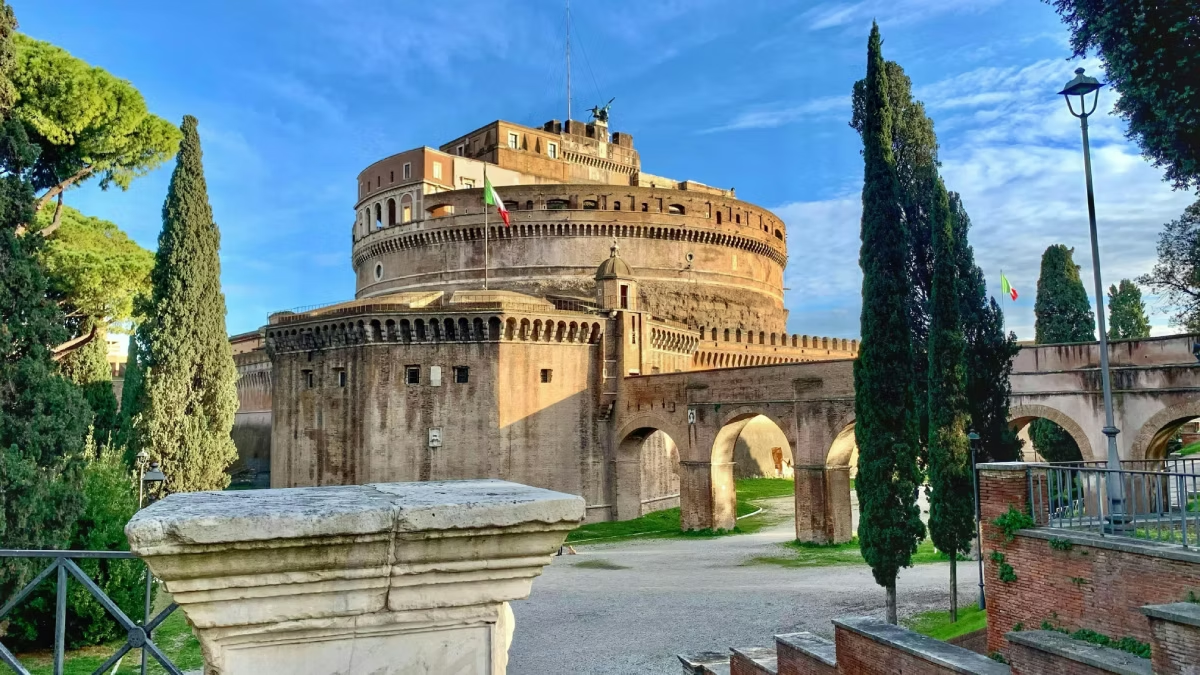
The Passetto di Borgo is an elevated, fortified corridor about 800 meters long that runs along the top of the old Leonine Walls, connecting Castel Sant’Angelo directly to the Vatican. Popes built and reinforced it as an emergency escape route, most famously used by Clement VII during the 1527 Sack of Rome. It is not open year-round — access is seasonal and sometimes limited to special guided visits, so check the official schedule before you plan around it.
Most visitors photograph the Passetto di Borgo without knowing what it is: a raised stone corridor, walled and roofed in places, running along the top of the fortifications between Castel Sant’Angelo and the Vatican. It looks unremarkable from street level in Borgo, but it was one of the most consequential pieces of defensive engineering in papal Rome — the private, protected route a pope could use to disappear from the Vatican and reappear, safely, inside the castle.
Its single most dramatic moment came in 1527, when Pope Clement VII reportedly ran along it to escape an invading army. That story, plus a cameo in a Dan Brown thriller, has made the Passetto one of the more talked-about features of a visit here — even though, in practice, most travelers never actually walk it.
What Is the Passetto di Borgo?
The Passetto di Borgo (“little passage of Borgo”) is a raised, fortified corridor roughly 800 meters long, built on top of the ancient walls that once enclosed the Borgo district between St. Peter’s and the Tiber. It gave popes a direct, defensible link between the Vatican Palace and Castel Sant’Angelo, away from the streets below.
The name translates loosely as “the little passage of Borgo,” and it describes the structure well: a narrow, elevated walkway sitting atop the old defensive wall that once ringed the Borgo neighborhood between the Vatican and the river. From the Apostolic Palace near St. Peter’s, it runs in a fairly straight line south to the castle, letting a pope (or anyone else with access) move between the two without ever setting foot on an open street. In an era when Rome’s streets could turn dangerous within hours — during a riot, a siege, or an invading army’s advance — that was an enormously valuable piece of infrastructure.
Built and Heightened by Popes
The Borgo walls that carry the Passetto date to the 9th century, but the elevated covered corridor as an escape route took shape later, developed under Pope Nicholas III in the 13th century and substantially reinforced by Pope Alexander VI around 1500, turning it into the fortified papal passage still visible today.
The walls beneath the Passetto have deep roots: Pope Leo IV had the Borgo enclosed with defensive walls in the 9th century after a Saracen raid threatened St. Peter’s, creating the fortified district still known as the Leonine City. It was Pope Nicholas III, in the late 13th century, who is generally credited with formalizing the elevated corridor along the top of those walls as a direct, protected link from the Vatican to the castle — giving the papacy a private route it could use in a crisis rather than relying on the mausoleum and its walls purely as separate strongpoints.
The Passetto reached the form closest to what survives today under Pope Alexander VI (Rodrigo Borgia), around the turn of the 16th century. Alexander VI strengthened and heightened the corridor as part of a broader program of fortifying Castel Sant’Angelo itself, aware that the Borgia papacy had no shortage of enemies. That reinforcement proved prescient: within a generation, his successors would need every bit of that protected passage.
The 1527 Escape: Clement VII and the Sack of Rome
On May 6, 1527, as mutinous troops of Charles V’s army broke into Rome and began the brutal Sack of Rome, Pope Clement VII fled the Vatican Palace and ran along the Passetto di Borgo to the safety of Castel Sant’Angelo, where he held out under siege for months.
This is the event the Passetto is best known for. As the imperial army — a largely unpaid, undisciplined force of Spanish and German troops — poured into Rome on the morning of May 6, 1527, Clement VII and a group of cardinals and household staff reportedly ran the length of the corridor from the Vatican Palace straight into Castel Sant’Angelo, reaching the fortress just ahead of the invaders. Without the Passetto, the pope’s options for reaching the castle would have meant crossing open, chaotic streets already filling with soldiers.
Clement VII then endured a siege inside the castle that lasted roughly six weeks before he negotiated a surrender, while much of the rest of Rome was subjected to weeks of looting, violence, and destruction — an event historians often treat as marking the symbolic end of the High Renaissance in Rome. The Passetto’s role in that single dash is the detail most guides and visitors remember, and it is the reason the corridor still carries the nickname “the pope’s escape route” today.
How It Works: Built Atop the Leonine Walls
The Passetto is not a tunnel but an elevated, covered walkway built directly on top of the defensive walls enclosing the Borgo, running about 800 meters at rooftop height above the surrounding streets. That elevation is what made it defensible — attackers below could not easily reach or block it, and defenders could move along it under cover.
It helps to picture the Passetto correctly: it is not underground, and it is not a secret tunnel in the way popular retellings sometimes imply. It sits on top of the ancient Leonine Walls, elevated well above street level, running along the wall’s crown behind battlements and, in sections, under a roofed or partially enclosed passage. That height and enclosure are the whole point — a corridor running above the rooftops of Borgo could be defended by a handful of guards against a mob or an advancing force below, something a street-level route never could.
Along its roughly 800-meter length, the Passetto connects the Vatican’s Apostolic Palace area to the upper levels of Castel Sant’Angelo, threading past and above the Borgo’s narrow lanes. Sections of the wall and corridor have been altered, rebuilt, or partly demolished over the centuries — most notably when Mussolini’s government cut the broad boulevard of Via della Conciliazione through the old Borgo in the 1930s, which required removing part of the historic streetscape around the wall, though the Passetto itself largely survived.
The Passetto in Pop Culture: Angels & Demons
The Passetto’s dramatic backstory made it a natural fit for Dan Brown’s 2000 novel Angels & Demons and its 2009 film adaptation, where the corridor is depicted as a secret escape route used by a character fleeing danger between the Vatican and the castle. The film’s version simplifies and dramatizes the real history, but the core idea — a hidden, elevated passage linking the two — is grounded in genuine Renaissance-era engineering. That fictional treatment has done a lot to introduce the Passetto to visitors who might otherwise walk past it without a second glance, and “the Angels & Demons passage” is now a common way travelers ask about it, even though the on-screen sequences were largely filmed elsewhere.
Can You Visit? The Seasonal Reality
The Passetto di Borgo is not open year-round and is not automatically included with a standard Castel Sant’Angelo ticket. Access runs on a seasonal basis, often in summer, and is sometimes limited to special, separately ticketed guided visits organized by the museum. Always confirm current access and how to book on the official Castel Sant’Angelo site before you build your visit around walking it.
This is the part worth being honest about: the Passetto is a real, physically walkable part of Castel Sant’Angelo, but it is not a standard stop on a normal visit the way the terrace or the papal apartments are. Access has historically been limited and irregular — opened for a stretch of the summer season in some years, offered only through pre-booked guided tours in others, and occasionally closed for restoration work with no walk-in access at all. It is not included by default in the general admission ticket, and when it is open, it is often via a separate, additional booking rather than something you can simply walk into once inside the castle.
Because the schedule shifts from year to year and even season to season, do not build a Rome itinerary around a Passetto visit without checking first. The most reliable approach is to look at the official Castel Sant’Angelo website or call ahead close to your travel dates, and to ask directly whether Passetto access is currently offered, on what days, and whether it requires its own ticket or a guided-tour booking. If you are visiting during Rome’s Cultural Heritage Days or a similar seasonal event, that is one of the more likely windows when limited-access sites like the Passetto open to the public — but this varies by year and is never guaranteed. Our guide to Castel Sant’Angelo’s opening hours covers the museum’s standard daily schedule, which is separate from the Passetto’s own occasional openings.
What You’ll See If It’s Open
On the rare occasions the Passetto is open to visitors, the experience is quite different from the rest of the castle. Rather than frescoed papal rooms or a broad terrace view, you walk along a narrow, elevated stone corridor with a soldier’s-eye view over the rooftops of the Borgo district below, sandwiched between defensive walls that have stood since the Renaissance. It is a much more intimate, atmospheric experience than the main museum route — you are tracing the exact physical path a fleeing pope once ran, at the height he ran it, rather than just reading about the event on a placard. Guided visits, when offered, typically include commentary on the 1527 escape and the corridor’s construction, and may be capped at small group sizes given the narrow width of the passage. Expect a walk, not a museum stop — sturdy shoes and a tolerance for tight, exposed stretches of walkway are worth planning for if you do manage to book a spot.
Frequently Asked Questions
What is the Passetto di Borgo?
It’s an elevated, fortified stone corridor about 800 meters long, built atop the old Leonine Walls, connecting the Vatican Palace directly to Castel Sant’Angelo. Popes used it as a protected escape route between the two, most famously in 1527.
Who built the Passetto di Borgo?
The walls it sits on date to the 9th-century Leonine fortifications built under Pope Leo IV. The elevated corridor itself took shape under Pope Nicholas III in the 13th century and was significantly reinforced by Pope Alexander VI around 1500.
Why was the Passetto di Borgo built?
It gave the pope a direct, defensible route between the Vatican and Castel Sant’Angelo that avoided the open streets of Rome, useful during riots, sieges, or invasions. It functioned as an emergency escape corridor rather than an everyday walkway.
What happened at the Passetto in 1527?
During the Sack of Rome, Pope Clement VII fled the Vatican and ran along the Passetto to reach the safety of Castel Sant’Angelo just ahead of the invading imperial troops. He then withstood a siege inside the castle for about six weeks.
Can you walk the Passetto di Borgo today?
Sometimes, but not on a standard visit. Access is seasonal, often limited to summer months or special guided visits, and it is usually a separate, additional booking rather than something included in general admission. Check the official site for current availability.
Is the Passetto included in the regular Castel Sant’Angelo ticket?
No, it should not be assumed to be included. Standard entry tickets cover the museum’s usual route through the courtyards, papal apartments, and terrace; Passetto access, when offered, is typically arranged and ticketed separately.
Is the Passetto di Borgo the same passage from Angels & Demons?
Yes, in concept — Dan Brown’s novel and the 2009 film depicted a secret escape corridor between the Vatican and the castle inspired by the real Passetto di Borgo, though the story and specific scenes are fictionalized.
How long is the Passetto di Borgo?
It runs approximately 800 meters, roughly half a mile, connecting the area of the Vatican’s Apostolic Palace to Castel Sant’Angelo along the top of the old Borgo walls.
Is the Passetto a tunnel?
No. Despite sometimes being described as a “secret tunnel,” it is an elevated, roofed corridor built on top of the defensive walls, not an underground passage. Its height above the street is what made it defensible.
How do I check if the Passetto is open during my visit?
Check the official Castel Sant’Angelo website close to your travel dates, since openings are seasonal and change year to year. If it is open, it is often via a guided visit that needs booking in advance rather than a walk-in option.
