

Inside Castel Sant’Angelo: A Full Floor-by-Floor Walkthrough
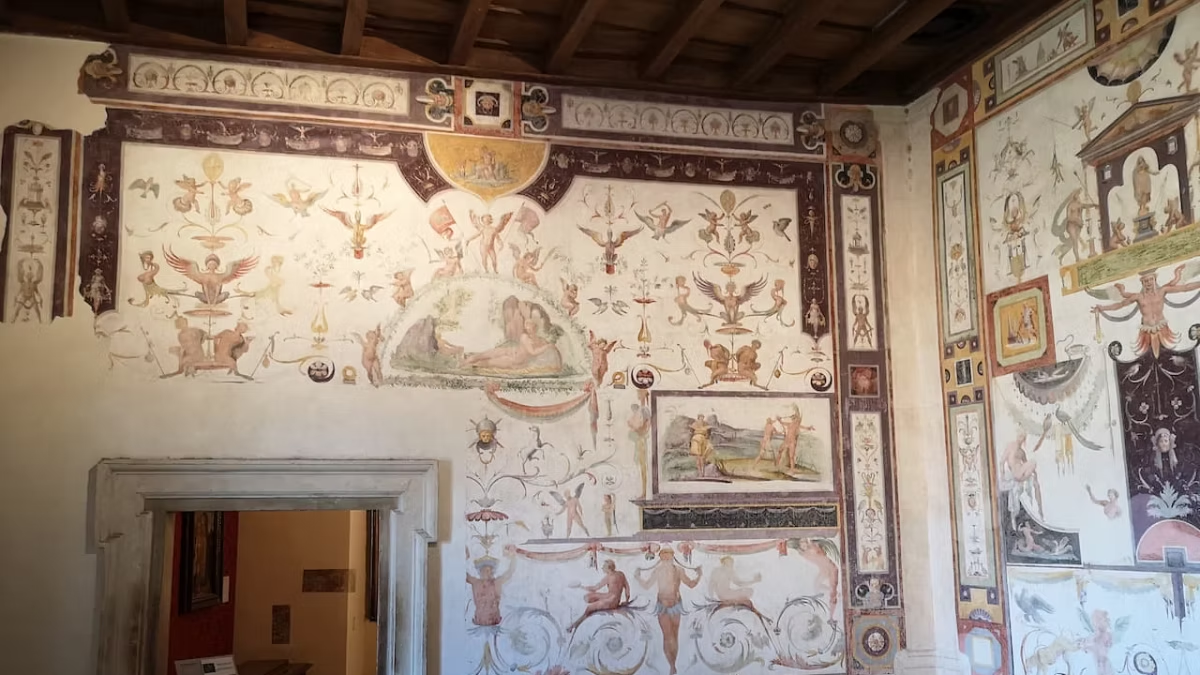
A visit to Castel Sant’Angelo climbs through roughly five levels, starting with Hadrian’s ancient spiral ramp, then the Renaissance Courtyard of the Angel, the armory and prison rooms, the frescoed papal apartments (Sala Paolina, Perseus room, Amore e Psiche room), the Treasury and library, and finally the rooftop Terrace of the Angel. The route is essentially one continuous climb, so the building itself tells the story of its own transformation from Roman tomb to papal fortress to museum.
Most visitors know Castel Sant’Angelo as “the round castle by the river” or the fortress from the terrace scene in Tosca, but the interior is really a layered building — a 2nd-century Roman mausoleum with a medieval and Renaissance fortress built on top of it, and a museum laid into what’s left. Walking through it in order, from the base to the roof, is the clearest way to actually feel that layering rather than just read about it.
This guide walks the standard visitor route level by level: what each space was originally for, what changed when the popes took it over, and what to actually look for as you pass through — so you know what you’re looking at rather than just following the crowd upward.
The Route Logic: One Climb, Three Buildings in One
The interior route works because it is essentially chronological — you start in the oldest surviving fabric (Hadrian’s 2nd-century core) and climb up through progressively later additions until you reach the 18th-century bronze angel above the terrace. There’s no real way to skip levels; the path is a single ascending spiral and a few connecting staircases.
Castel Sant’Angelo was built as Hadrian’s Mausoleum around AD 135–139, the tomb of the emperor and his successors up through Caracalla, roughly a century of imperial burials. In the early Middle Ages it was absorbed into Rome’s defenses and eventually into papal control, becoming a fortress and, when things got dangerous, a refuge — connected directly to the Vatican by the elevated Passetto di Borgo corridor. Renaissance popes then layered comfortable apartments onto the fortress shell, and later still the building did time as a prison. Since the early 20th century it has been a museum.
You don’t experience this history as a timeline on a wall; you experience it as a change in the architecture itself as you climb — cold, engineered Roman stonework at the bottom, then increasingly decorated, human-scaled rooms as you rise into the papal era, and finally an open rooftop that was a defensive gun platform before it was a viewpoint. For the fuller story behind all of this, see our guide to the history of Castel Sant’Angelo.
Level 0: Hadrian’s Helical Ramp
The visit begins inside Hadrian’s original mausoleum structure, on a stone spiral ramp built around AD 135–139 that winds upward inside the drum of the building. It’s the oldest part of the interior you’ll walk through and the clearest physical evidence that this was built as a tomb, not a castle.
Past the entrance, the route drops you straight into ancient Rome: a long, gently sloped, curving ramp cut into the base of Hadrian’s original cylindrical structure. This helical ramp was engineered so that funeral processions — and later, cartloads of material — could move upward inside the mausoleum without stairs. The walls are plain, thick Roman masonry, and the light is dim; niches along the way once held burial urns.
It’s worth slowing down here rather than treating it as a corridor to get through. This is the part of the building closest to its original AD 139 form, before any of the fortress or papal additions existed. Our dedicated guide to Hadrian’s Mausoleum and the helical ramp goes deeper into how the tomb was actually built and used before Rome’s later rulers repurposed it.
The Courtyard of the Angel (Cortile dell’Angelo)
The Cortile dell’Angelo is a Renaissance-era courtyard partway up the route, notable for a large 16th-century marble statue of the Archangel Michael — the predecessor to the bronze angel now on the roof — and for stacks of stone cannonballs left from the building’s centuries as an active fortress.
Emerging from the ramp, you reach the Courtyard of the Angel, one of several open-air courtyards built once the structure had become a fortified papal residence rather than a sealed tomb. The centerpiece is a weathered marble angel, an earlier version of the figure that now stands in bronze atop the terrace; it was damaged and replaced over the centuries, and this marble original was eventually moved down into the courtyard for protection. Nearby, tidy pyramids of stone cannonballs are a straightforward, physical reminder that this courtyard sat inside a working military structure, not a palace garden — Castel Sant’Angelo was besieged more than once, most famously during the 1527 Sack of Rome.
The courtyard is a natural pause point: it’s shaded, it’s a good photo spot, and it marks the transition from the raw Roman core below to the more decorated papal-era rooms above. If you’re curious why the building carries an angel motif at all, our guide to the statue of Saint Michael explains the 590 AD plague legend behind the name “Castle of the Holy Angel.”
The Armory and the Prison Cells
Between the courtyards and the papal apartments, the route passes through former storage and armory rooms and a set of small prison cells, some cut directly into the ancient masonry — a reminder that the castle held prisoners for centuries, including some well-documented historical figures.
This stretch of the route is deliberately plain and a little cramped after the open courtyard — thick-walled rooms that once stored weapons and supplies for a fortress under siege, alongside small cells where the papal government held prisoners from the Middle Ages into the 19th century. Some of these spaces are literally carved into Hadrian’s original Roman structure, repurposed centuries after they were built for an entirely different function (housing funeral urns, not people). It’s a stark, useful contrast to the ornate rooms just ahead.
If prison history interests you, our dedicated guide to the prison cells and its most famous prisoners covers who was actually held here and the more dramatic (and sometimes exaggerated) stories attached to this part of the castle.
The Papal Apartments: Sala Paolina, Perseus Room, and Amore e Psiche
The papal apartments are the most visually striking part of the interior — a sequence of Renaissance rooms commissioned by popes including Paul III, decorated with elaborate frescoes. The Sala Paolina is the grandest, with the Perseus room and the Amore e Psiche (Cupid and Psyche) room nearby, both named for their painted subjects.
This is where the building stops feeling like a fortress and starts feeling like a residence. The papal apartments were built and decorated in the 16th century as genuinely livable quarters for popes who might need to shelter here on short notice, and the decoration reflects that — this had to look and feel like papal authority, not a bunker. The Sala Paolina is the standout room: a large, fully frescoed hall with trompe l’oeil architecture, allegorical figures, and scenes tied to the Farnese pope Paul III who commissioned it. Adjoining rooms take their names from their subjects — the Perseus room and the Amore e Psiche (Cupid and Psyche) room — both painted with mythological scenes typical of Renaissance interior decoration for a powerful patron.
Give this section real time; it’s easy to rush through frescoed rooms when you’re focused on reaching the terrace, but the apartments are arguably the artistic core of the museum. Our dedicated guide to the papal apartments walks through the Sala Paolina’s frescoes and the two adjoining rooms in more detail.
The Treasury (Sala del Tesoro)
The Sala del Tesoro, or Treasury, is a smaller, heavily secured room historically used to store the papacy’s valuables and archives — cash, jewels, and important documents kept safe inside a fortress precisely because it was a fortress. The room itself, with its thick door and vault-like character, communicates the function almost without needing a label. It’s a brief stop compared to the apartments, but it reinforces a theme that runs through the whole building: Castel Sant’Angelo was chosen for exactly this kind of use again and again because it was, quite simply, the most defensible structure available near the Vatican.
The Library
Past the Treasury, a smaller library room holds part of the museum’s collection of historical volumes and documents connected to the castle’s centuries of use as archive and administrative center. It’s a quieter, less visually dramatic stop than the frescoed apartments, but it’s a useful reminder that this building functioned as a working seat of papal administration for long stretches of its history, not only as a refuge or prison.
The Terrace of the Angel
The Terrace of the Angel is the final stop on the route — the open rooftop platform beneath the bronze statue of the Archangel Michael, with a panoramic view over the Tiber, St. Peter’s Basilica, and central Rome. It’s also the setting for the climactic scene of Puccini’s opera Tosca.
After the enclosed rooms below, the terrace opens up all at once, and for most visitors this is the payoff for the climb. The 18th-century bronze angel by Peter Anton von Verschaffelt stands overhead, sheathing his sword — a reference to the plague legend that gave the castle its name. From the terrace itself you get one of the better panoramic views in central Rome, taking in the Tiber, Ponte Sant’Angelo below, and St. Peter’s dome across the river. It’s also, for opera fans, the setting of the final act of Tosca, where the heroine leaps from these same ramparts.
Because the terrace and upper levels start clearing before the museum’s 6:30 PM last-admission cutoff, don’t save it for the very end of your visit if you’re arriving late in the day. Our dedicated guide to the Terrace of the Angel covers the view in more detail, including how it compares to other Rome viewpoints and the best light for photos.
From Mausoleum to Fortress to Museum: Reading the Building as You Climb
Step back and the floor-by-floor route is really a compressed tour through roughly 1,900 years of the same footprint being reused for different purposes. The helical ramp and the drum around it are Hadrian’s original engineering from the AD 130s, built purely to house the dead. The courtyards, armory, and prison rooms date largely from the building’s centuries as a working fortress and papal stronghold, a role that hardened after the legendary 590 AD sighting of the Archangel Michael and intensified through medieval and Renaissance conflicts, most dramatically the 1527 Sack of Rome. The papal apartments represent a later, more confident phase, when popes had enough security to prioritize comfort and prestige alongside defense. The Treasury and library reflect the castle’s long secondary life as an administrative and storage center. And the terrace, capped by its bronze angel, is the building’s final identity: a monument and viewpoint rather than a tomb, a weapon, or a jail.
Knowing this arc doesn’t require memorizing dates — it’s mostly a matter of noticing, as you climb, that the walls get less military and more decorated, and that each level had a genuinely different job.
Planning the Walkthrough
A full floor-by-floor visit, taken at a reasonable pace with time to actually look at the frescoes and the view, is not a quick stop — budget more time than you’d expect from the building’s compact footprint, since the route is essentially one long, occasionally slow-moving climb with no shortcuts back down except the way you came (or a limited number of connecting stairs). Our guide on how long to spend at Castel Sant’Angelo breaks down realistic timing for a full interior visit versus a faster pass. A pre-booked entry ticket with a timed slot is worth it in peak season, since ticket-office lines can eat into the time you’d rather spend on the terrace.
Frequently Asked Questions
What is the order of rooms inside Castel Sant’Angelo?
The standard route runs from Hadrian’s helical ramp at the base, up through the Courtyard of the Angel, the armory and prison rooms, the papal apartments (Sala Paolina, Perseus room, Amore e Psiche room), the Treasury and library, and finally up to the rooftop Terrace of the Angel. It’s a single ascending path with limited branching.
How long does it take to walk through the whole castle?
A thorough visit that includes the apartments, the museum rooms, and time on the terrace typically takes a couple of hours; a faster pass focused mainly on the terrace and highlights can be shorter. See our guide on how long to spend for a fuller breakdown by visit style.
Is the walk uphill the whole way?
Yes, essentially. Hadrian’s original ramp has a gentle slope rather than steps, but higher levels involve stairs as you move between the courtyards, the apartments, and the terrace. There’s no elevator covering the full route, so anyone with mobility concerns should plan accordingly.
What is the Sala Paolina?
The Sala Paolina is the grandest room in the papal apartments, a fully frescoed 16th-century hall commissioned under Pope Paul III. It’s generally considered the artistic high point of the interior and is a highlight worth allowing real time for, not just a room to walk through quickly.
What are the Perseus room and the Amore e Psiche room?
They’re two smaller rooms adjoining the Sala Paolina in the papal apartments, each named for the mythological subject of its frescoes — Perseus in one, Cupid and Psyche (Amore e Psiche) in the other. Both date from the same Renaissance decorating campaign as the main hall.
What is in the Treasury (Sala del Tesoro)?
The Sala del Tesoro was historically used to secure papal valuables, cash, and archives, taking advantage of the building’s fortress-level security. It’s a smaller, more functional stop compared to the frescoed apartments, but it underscores why the castle was repeatedly chosen for this kind of use.
Can you see the prison cells inside the castle?
Yes. Small cells and former holding rooms sit along the route between the lower levels and the papal apartments, and some are cut directly into the ancient Roman masonry. Our dedicated prison guide covers who was historically held here and the stories attached to those rooms.
Is the Terrace of the Angel included in the standard ticket?
Yes, the terrace is the final stop on the standard museum route and is included in regular admission — it isn’t a separate paid add-on. It’s also where the top of the visit’s climb pays off with a panoramic view over Rome.
Do I need to book ahead to walk this full route?
You don’t strictly need to, but a pre-booked timed-entry ticket avoids ticket-office queues that can be long in peak season, leaving more of your visit for actually walking the route rather than waiting in line.
Is the walkthrough the same every day the castle is open?
The core route is consistent, but individual rooms can occasionally close for restoration or be adjusted for temporary exhibitions, and the castle is closed entirely on Mondays. If a specific room is a priority for you, it’s worth checking current notices on the official site before your visit.
