

The Prison Cells & Famous Prisoners of Castel Sant’Angelo
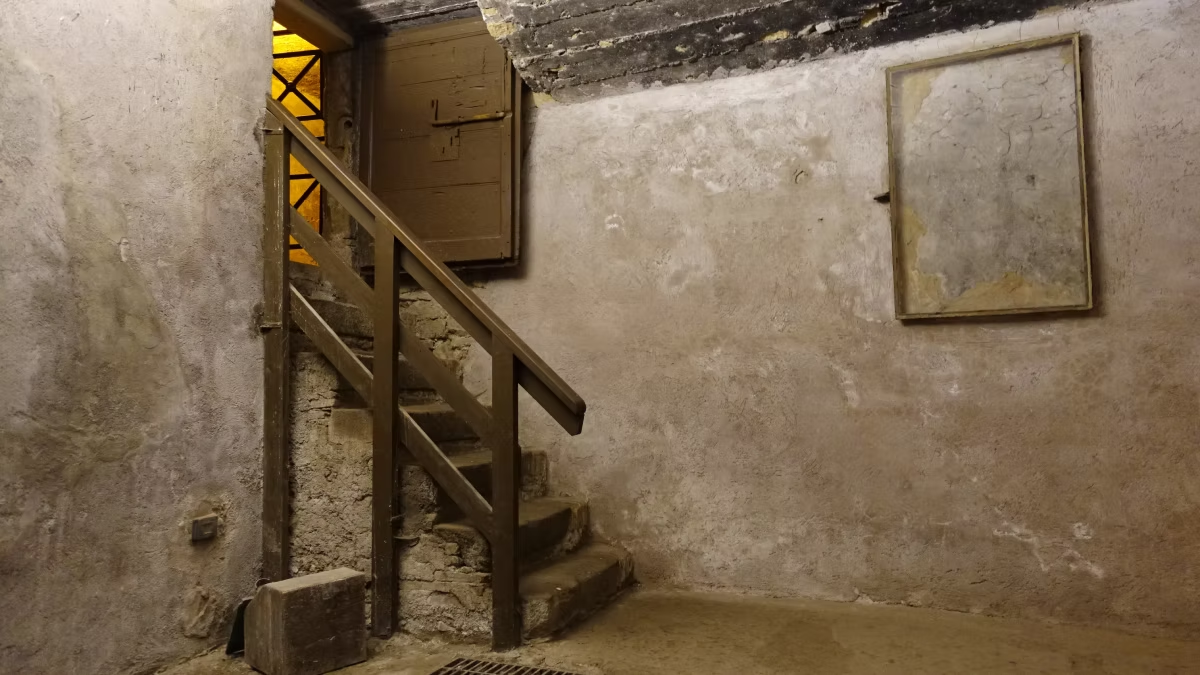
For roughly three centuries, Castel Sant’Angelo served the popes as a fortified prison, holding everyone from disgraced cardinals to condemned heretics in small, windowless cells cut into the ancient stone. Its best-known inmates include the goldsmith Benvenuto Cellini, who wrote a vivid account of his escape; the noblewoman Beatrice Cenci, executed in 1599; the philosopher Giordano Bruno; and the occultist Cagliostro. Visitors today can walk through a handful of surviving cells on the museum route, a somber counterpoint to the frescoed papal apartments upstairs.
Long before it was a museum, Castel Sant’Angelo was one of the most feared addresses in Rome. Once the popes took over Hadrian’s ancient mausoleum as a fortress and refuge, its thick walls and single defensible entrance made it an obvious place to hold people the church wanted kept close, quiet, or simply out of the way — from petty debtors to some of the most consequential prisoners in Italian history. Our history of Castel Sant’Angelo traces how the tomb became a fortress and, eventually, a prison.
This guide covers the cells themselves, the conditions prisoners faced, the stories of the castle’s most famous inmates, what remains to see of the prison today, and the opera that immortalized the castle’s darker history.
A Fortress Turned Prison
From the medieval period through the 18th century, the popes used Castel Sant’Angelo as a state prison alongside its roles as fortress and refuge, holding political enemies, accused heretics, common criminals, and even members of the clergy. Its isolation — surrounded by walls and reachable only through a single controlled entrance — made escape extraordinarily difficult and made the castle a natural place of last resort for prisoners the papacy considered dangerous.
The castle’s prison role grew directly out of its military one. Once popes such as Nicholas III and Boniface IX had reinforced Hadrian’s mausoleum into a proper stronghold, its lower levels and side chambers were pressed into use for confinement — first informally, holding whoever a pope or his officials wanted secured during moments of unrest, and later as a more established part of how the Papal States handled its own prisoners of conscience and prisoners of state. Unlike a purpose-built prison, the cells were carved and adapted from existing spaces within the ancient core, which is part of why conditions inside were so poor.
Inside the Cells: Cramped, Dark, and Damp
The cells cut into Castel Sant’Angelo’s ancient core were small, windowless, and poorly ventilated, some little more than stone niches barely large enough to lie down in. The most feared of them, sometimes referred to as the “Sammalò,” functioned much like a French oubliette — a sealed, below-ground chamber where a prisoner could be left with little hope of being remembered, let alone released.
Because the prison cells were built into the solid Roman masonry of Hadrian’s original tomb rather than purpose-designed, most offered no natural light and little air. Inmates of standing — cardinals, nobles, and other prisoners the church wanted kept comfortable enough to negotiate with — might be held in a furnished room with a view, but ordinary or politically dangerous prisoners were shut into bare stone cells, sometimes for years. The harshest of these spaces functioned as an oubliette: a term that comes from the French “oublier,” to forget, describing a cell reached only from above and sealed once a prisoner was inside. Conditions were damp, cold in winter, and stifling in summer, and prisoners relied on jailers for food, water, and any contact with the outside world. It is not hard to see why the castle acquired a reputation, in Rome and beyond, as a place people entered and did not always leave.
Benvenuto Cellini: The Goldsmith Who Escaped
The Florentine goldsmith and sculptor Benvenuto Cellini was imprisoned at Castel Sant’Angelo in 1538–39 by Pope Paul III, accused of stealing papal jewels during the chaos of the 1527 Sack of Rome. Cellini later wrote a dramatic, first-person account of climbing down from his cell using knotted bedsheets — an escape that ended with a broken leg, recapture, and eventual release.
Cellini is probably the castle’s most vividly documented prisoner, because he told the story himself. In his autobiography, “The Life of Benvenuto Cellini,” he describes months of imprisonment, a first escape attempt using sheets tied together and lowered from a high window, a fall that broke his leg on the way down, and his recapture soon after within the city. He was eventually released through the intervention of well-placed patrons, including a cardinal who negotiated on his behalf, and went on to a long career as one of the era’s most celebrated goldsmiths and sculptors. His account, written decades later and colored by his considerable ego, remains one of the liveliest surviving descriptions of what it actually felt like to be held inside the castle’s walls.
Beatrice Cenci: A Tragic and Enduring Story
Beatrice Cenci, a young Roman noblewoman, was held prior to her 1599 execution after being convicted of conspiring in the murder of her abusive father, Francesco Cenci. She was beheaded on Ponte Sant’Angelo, just outside the castle walls, and her case became one of the most sympathetic and debated in Roman history — a story of an abused daughter punished by the same authority that had ignored her suffering.
Beatrice Cenci’s story is one of the castle’s most somber. Her father, Francesco Cenci, was by contemporary accounts a violent and abusive man, and Beatrice, along with her stepmother and brothers, was implicated in his murder in 1598. Despite widespread sympathy in Rome — many saw the family as victims who had exhausted every legal option before acting — Pope Clement VIII refused clemency, and Beatrice was executed along with her stepmother and brother on September 11, 1599, on Ponte Sant’Angelo, in sight of the castle. She was not held in the deepest oubliette-style cells, but her imprisonment in the castle’s precincts and her public execution on the bridge just outside cemented Castel Sant’Angelo’s association with her case in the Roman imagination. Her story has inspired centuries of art and literature, including Percy Bysshe Shelley’s play “The Cenci,” and she is still remembered in Rome as a symbol of a young woman failed by the justice of her time.
Giordano Bruno: Held Before His Execution
The philosopher and former friar Giordano Bruno spent years in the custody of the Roman Inquisition, with tradition holding that part of his imprisonment took place within Castel Sant’Angelo before his trial concluded. He was burned at the stake in Campo de’ Fiori in 1600 after refusing to recant views the church judged heretical, and he is remembered today as an early martyr for freedom of thought.
Bruno’s case is one of the most consequential in the history of the Roman Inquisition. Arrested in Venice in 1592 and extradited to Rome the following year, he spent roughly seven years in custody while church authorities investigated his writings on cosmology, philosophy, and theology, including his defense of an infinite universe with countless worlds. Guide tradition holds that Bruno was confined for a period within Castel Sant’Angelo’s cells during this long imprisonment, alongside other Inquisition holding sites in the city; the precise record of where he was held at each stage is not fully documented, so this detail is worth treating as tradition rather than settled fact. What is certain is the outcome: Bruno refused to recant, was condemned as an unrepentant heretic, and was burned at the stake in Campo de’ Fiori on February 17, 1600. A statue on that square today marks the spot, and Bruno is widely regarded as an early symbol of the cost of intellectual dissent.
Cagliostro: The Alchemist’s Final Roman Chapter
The self-styled count and alchemist Alessandro Cagliostro (born Giuseppe Balsamo) was arrested in Rome in 1789 and held at Castel Sant’Angelo while the Inquisition tried him for freemasonry and heresy. Sentenced to death, a punishment commuted to life imprisonment, he was later transferred to the fortress of San Leo, where he died in 1795.
By the late 18th century, Cagliostro had built an international reputation as a healer, mystic, and freemason, moving through the courts of Europe with a mix of showmanship and genuine influence. That reputation caught up with him in Rome, where the Inquisition arrested him in 1789 on charges tied to freemasonry, which the church treated as a serious offense. He was held at Castel Sant’Angelo during his trial, which concluded with a death sentence that Pope Pius VI commuted to life imprisonment. Cagliostro was subsequently moved to the more remote fortress of San Leo in the Apennines, where he died in 1795 — but his time at Castel Sant’Angelo marks the last chapter of his story played out in Rome itself, and his name is still attached in castle lore to one of the cells on the prison level.
Cardinals, Nobles, and Conspirators
Cellini, Cenci, Bruno, and Cagliostro are the names most visitors recognize, but the castle’s prison held a much wider cross-section of Rome’s political and religious life over the centuries. Cardinal Carlo Carafa, nephew of Pope Paul IV and a powerful figure during his uncle’s reign, was arrested after Paul’s death on charges that included murder and abuse of power, and was strangled inside Castel Sant’Angelo in 1561 on the order of Pope Pius IV — a rare instance of a cardinal executed within the castle itself rather than in public. Cesare Borgia, son of Pope Alexander VI, was briefly held there in 1503 amid the political scramble that followed his father’s death, before being allowed to leave Rome. Beyond these named cases, the prison regularly held lesser-known conspirators against papal authority, corrupt officials, and clergy accused of crimes the church preferred to handle behind closed walls rather than in a public court — a reminder that for much of its history, Castel Sant’Angelo functioned as both a symbol of papal power and one of its instruments.
What Visitors Can See of the Prison Today
A handful of the castle’s original prison cells survive on the museum route and are open to visitors as part of standard admission, typically on the lower and middle levels near the historic armory. The rooms are small, plain, and largely unrestored — a deliberate contrast to the frescoed grandeur of the papal apartments elsewhere in the castle — and some carry traditional associations with specific prisoners, including a cell popularly linked to Cagliostro.
The surviving cells are not a separate attraction requiring extra booking; they are part of the same route covered by the standard entry ticket, tucked among the museum’s historical rooms and the old armory collection. Compared with the richly decorated Sala Paolina and other papal apartments, the prison rooms are strikingly bare: thick stone walls, low doorways, and little natural light. Some visitors notice faint graffiti scratched into the stone by long-ago inmates, a small but affecting trace of the people who passed through. There’s no reenactment or theatrical staging here — the rooms are presented plainly, which suits the subject. Our floor-by-floor walkthrough of Castel Sant’Angelo shows where the prison level sits relative to the rest of the route, and it’s worth budgeting a few extra minutes here rather than rushing through, since it’s easy to walk past without registering what the space once was.
The Tosca Connection
Castel Sant’Angelo’s real history as a papal prison and execution site directly inspired the setting of Act 3 of Puccini’s opera “Tosca,” in which the painter Cavaradossi is held and executed within the castle before Tosca leaps from the terrace above. Puccini and his librettists drew on the castle’s genuine reputation rather than inventing it, which is part of why the ending still resonates with visitors who know the building’s history.
In the opera, Cavaradossi is imprisoned in Castel Sant’Angelo as a political prisoner, awaiting execution by firing squad in the castle’s precincts, while Tosca schemes to save him and ultimately loses everything. It is fiction, but it is fiction grounded in a real institution: audiences in Puccini’s day, and Romans for centuries before them, understood Castel Sant’Angelo as a place where the condemned were actually held and where executions actually happened, which gives the final act its particular weight. The opera’s famous leap from the ramparts takes place on the same Terrace of the Angel that visitors reach at the end of a real visit today, making the prison level and the terrace two ends of the same story, four centuries apart. Our guide to Tosca and Castel Sant’Angelo goes deeper into the opera’s connection to the castle’s real history.
Visiting This Part of the Castle Thoughtfully
The prison cells and the stories attached to them touch on execution, torture, and long-term confinement, and they’re worth approaching with the same respect you’d bring to any historic site tied to real suffering. Nothing here is played for shock value or reenacted for effect; the rooms are simply left as they are, which tends to make more of an impression than any dramatization would. If you’re visiting with children, our guide to visiting with kids has notes on which parts of the castle suit younger visitors and which are better suited to older children who can handle a frank account of the past. Remember, too, that the castle is closed on Mondays, so this is one more reason to plan your visiting day in advance.
Frequently Asked Questions
Can visitors still see the prison cells at Castel Sant’Angelo?
Yes. A number of the original cells survive and are included on the standard museum route, generally on the lower and middle levels near the historic armory rooms. No separate ticket or booking is needed beyond regular admission.
Who was the most famous prisoner held at Castel Sant’Angelo?
There isn’t a single answer, but Benvenuto Cellini is probably the best documented, since he wrote his own account of his imprisonment and escape. Beatrice Cenci, Giordano Bruno, and Cagliostro are also widely associated with the castle’s history as a papal prison.
Did Benvenuto Cellini really escape from Castel Sant’Angelo?
According to his own autobiography, yes — Cellini describes climbing down from a high window using knotted bedsheets, breaking his leg in the fall, and being recaptured soon after. He was eventually released through the intervention of influential patrons.
Was Beatrice Cenci executed inside the castle?
No. She was held in the castle’s precincts before her 1599 execution, but she was beheaded on Ponte Sant’Angelo, the bridge directly outside the castle walls, along with her stepmother and brother.
Was Giordano Bruno imprisoned at Castel Sant’Angelo?
Tradition holds that part of his roughly seven years in Inquisition custody was spent within the castle, though the full record of where he was held at each stage isn’t completely documented. He was ultimately executed at Campo de’ Fiori in 1600, not at the castle itself.
What is the “Sammalò” cell?
It’s the traditional name given to one of the castle’s harshest cells, a sealed, windowless chamber that functioned much like a French oubliette, where a prisoner could effectively be forgotten. It illustrates just how severe conditions could be for prisoners the papacy wanted permanently out of the way.
Were executions carried out at Castel Sant’Angelo itself?
Some were, including Cardinal Carlo Carafa’s strangulation within the castle in 1561, but many of Rome’s most famous executions, including Beatrice Cenci’s and Giordano Bruno’s, took place at public sites nearby, such as Ponte Sant’Angelo and Campo de’ Fiori, rather than inside the castle walls.
How does the prison connect to the opera Tosca?
Puccini’s “Tosca” sets its final act at Castel Sant’Angelo, with the character Cavaradossi imprisoned and executed there before Tosca’s famous leap from the terrace. The scene draws directly on the castle’s real history as a papal prison and place of execution.
Is the prison section suitable for children?
Most families find the cells appropriate for children, since nothing is graphically staged, but the subject matter, including references to executions and harsh imprisonment, is more meaningful for older kids who can follow the history. Our guide to visiting with kids has more specific age-by-age guidance.
How much time should I set aside for this part of the visit?
Ten to fifteen minutes is usually enough to see the cells and read the panels, though history-minded visitors often linger longer. It fits naturally into a full visit that also takes in the papal apartments and the terrace.
