

Tosca at Castel Sant’Angelo: Puccini’s Third Act Explained
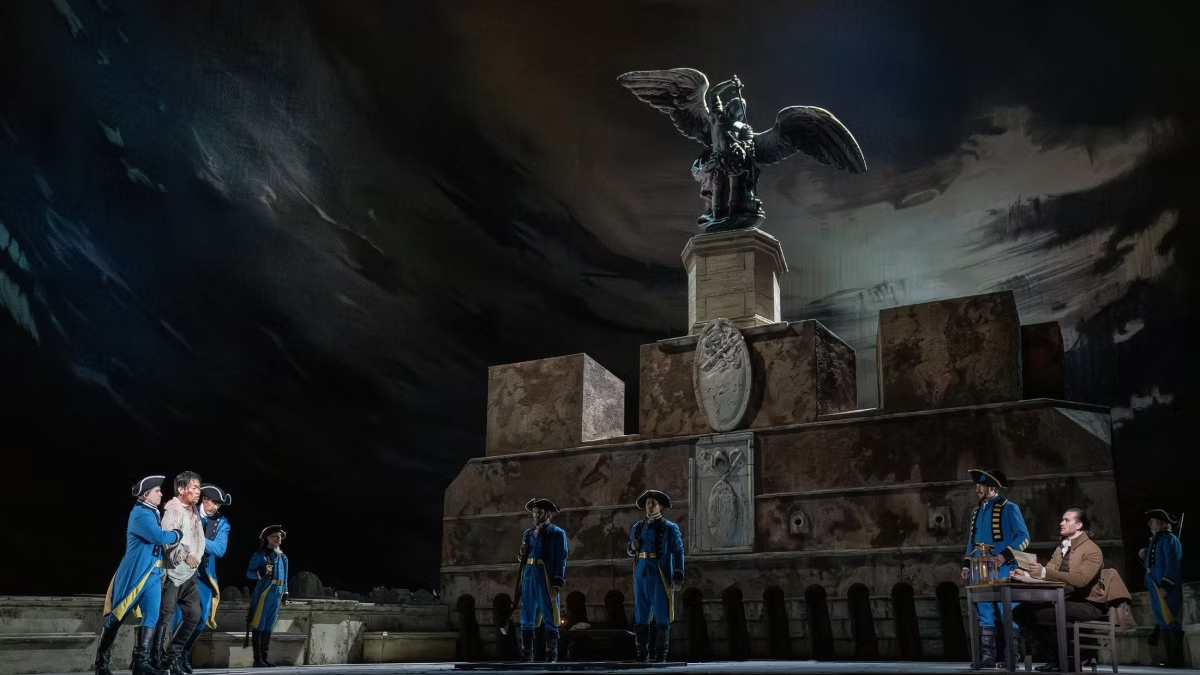
Giacomo Puccini’s 1900 opera Tosca closes with Act 3 set on the roof of Castel Sant’Angelo at dawn, where the singer Floria Tosca leaps to her death from the ramparts after her lover, the painter Mario Cavaradossi, is executed. Puccini set all three acts in real Rome buildings — the church of Sant’Andrea della Valle, the Palazzo Farnese, and the castle itself — which is why the terrace draws opera lovers who want to stand where the story ends. You don’t need to know the opera to enjoy the view, but knowing it adds a layer most visitors miss.
If you’ve heard the castle mentioned in the same breath as an opera and wondered why, the answer is Tosca. Puccini’s tragedy is one of the most performed operas in the world, and its final act unfolds on the exact rooftop that visitors climb to today. For opera fans, that makes an ordinary museum visit into something closer to a pilgrimage; for everyone else, it’s a good story to have in your back pocket while you’re up there.
This guide covers the plot of Tosca in brief, what happens in the famous Act 3 finale, how the opera’s three acts trace a real route across Rome, why the terrace matters so much to opera lovers, what to notice while you’re standing on it, and the historical moment — Rome in 1800 — that Puccini set the story in.
The Plot of Tosca in Brief
Tosca is a love triangle turned political tragedy. The singer Floria Tosca loves the painter Cavaradossi, who is hiding an escaped political prisoner; the corrupt police chief Baron Scarpia wants Tosca for himself and uses Cavaradossi’s arrest to try to get her, with fatal results for all three by the final curtain.
Giacomo Puccini’s opera, first performed in Rome in January 1900, is built on three characters. Floria Tosca is a celebrated opera singer, passionate and devout. Mario Cavaradossi is a painter and her lover, a man with republican sympathies in a city ruled by the pope’s police. Baron Scarpia is Rome’s chief of police, a manipulative figure who desires Tosca and is willing to use torture, blackmail, and betrayal to get what he wants.
The story opens when Cavaradossi shelters Angelotti, an escaped political prisoner, inside the church where he is painting. Scarpia, hunting the fugitive, arrests Cavaradossi and has him tortured within Tosca’s hearing to force information out of her. He then offers Tosca a deal: he will arrange a fake execution for Cavaradossi — blanks instead of bullets — if she will submit to him. Tosca appears to agree, but at the moment Scarpia moves to claim his reward, she stabs him to death and takes the safe-conduct pass he had signed for her and Cavaradossi to leave Rome.
Believing the execution will be staged, Tosca goes to Cavaradossi at dawn to tell him the plan. What she does not know — and what she discovers only after the soldiers fire — is that Scarpia betrayed her one final time: the bullets are real, and Cavaradossi is dead. When Scarpia’s men come to arrest her for his murder, Tosca climbs the parapet and throws herself off, choosing death over capture.
Act 3: Puccini’s Castel Sant’Angelo Finale
Act 3 opens on the roof of Castel Sant’Angelo before dawn, moves through a tender final scene between Tosca and Cavaradossi as he awaits what he believes is a mock execution, and ends with his real death by firing squad and Tosca’s leap from the ramparts moments later.
Puccini sets the entire third act on the castle’s rooftop, using the setting itself to build the drama. The act opens quietly, with a shepherd’s song and the sound of church bells drifting up from the city below as the sky lightens — one of the opera’s most atmospheric passages, evoking Rome waking up around a man who is about to die. Cavaradossi is brought up to the terrace under guard, and in the time before the firing squad arrives he writes a farewell letter and sings “E lucevan le stelle” (“And the stars were shining”), one of the best-known tenor arias in the repertoire, mourning the life and love he is about to lose.
Tosca arrives with the safe-conduct pass and tells him about the arrangement with Scarpia, believing they are hours from freedom together. The soldiers march Cavaradossi to the parapet, fire, and leave. Tosca urges him to stay still until they’re gone and to play his part well — only to find, when she goes to him, that he is truly dead. Scarpia’s betrayal is complete even from beyond the grave. As Scarpia’s men arrive to arrest her for his murder, Tosca climbs onto the ramparts and jumps, ending the opera on the same rooftop where it began its final hour.
How Tosca’s Three Acts Map to Real Rome
Puccini and his librettists set Tosca in three real Rome landmarks: Act 1 in the church of Sant’Andrea della Valle, Act 2 in the Palazzo Farnese, and Act 3 on the roof of Castel Sant’Angelo — a geography that roughly follows a walkable route across the historic center to the Tiber.
Unlike most operas, which take place in invented or generic settings, Tosca is tied to specific, still-standing buildings, and the plot moves through them in something close to real time and real distance.
Act 1 — Sant’Andrea della Valle. The opera opens inside this Baroque church near Piazza Navona, where Cavaradossi is painting a Mary Magdalene fresco and where Angelotti hides in the Attavanti family chapel. The church still stands and is open to visitors, its dome one of the tallest in Rome after St. Peter’s.
Act 2 — Palazzo Farnese. The second act takes place in Scarpia’s apartments, which Puccini locates inside the Palazzo Farnese, a Renaissance palace a short walk from the church. This is where Cavaradossi is interrogated, where Tosca strikes her bargain, and where she kills Scarpia. The palace today houses the French Embassy and is not generally open for casual visits, but its facade on Piazza Farnese can be seen from the street.
Act 3 — Castel Sant’Angelo. The final act moves to the castle’s rooftop, on the far side of the Tiber from the other two locations. The geography works: a prisoner moved from the Farnese toward Castel Sant’Angelo, historically used as a papal prison and fortress, is a plausible route through the city, and it gives the opera a natural rise in altitude and tension as the story climbs from a church, to a palace, to a rooftop at dawn.
Taken together, the three acts trace a route any visitor can actually walk — church, palace, castle — which is part of why Tosca has such a strong pull on people visiting Rome with the opera in mind.
Why the Terrace Is a Pilgrimage for Opera Lovers
For anyone who knows the opera, the Terrace of the Angel is not just a viewpoint — it’s the physical stage for one of the most famous final scenes in the repertoire. Standing where “E lucevan le stelle” is sung, looking out over the same rooftops and the same dawn light Puccini wrote into the music, is a different experience than reading about it or hearing a recording. Opera companies and singers have made the connection literal at times, including open-air performances staged at or near the castle itself, and the terrace shows up regularly in discussions of “opera pilgrimage” sites alongside places like Milan’s La Scala or Bayreuth.
Part of the appeal is that the emotional arc of the act matches the physical experience of the climb. Visitors ascend through Hadrian’s spiral ramp, Renaissance courtyards, and papal rooms before finally reaching open sky at the top — not unlike the way the opera builds from an interrogation in a palace room to a single exposed rooftop at dawn. You don’t have to be an opera buff to feel that shift; it’s built into the architecture.
What to Look for on the Terrace with Tosca in Mind
If you want to connect the opera to what you’re actually seeing, a few details are worth watching for on the terrace. The statue of the Archangel Michael that crowns the castle — the 18th-century bronze that gives the building its name — looks out over the same skyline Cavaradossi describes in his farewell aria; picking it out first orients you to the rest of the view. Look east toward the historic center and you’re looking roughly in the direction of Sant’Andrea della Valle and the Palazzo Farnese, the settings of Acts 1 and 2, even though neither is visible in detail from this distance. The parapets themselves — the low stone walls ringing the terrace — are the ramparts of the final scene; modern railings and barriers are in place for visitor safety, a reminder that the drama is fictional even though the setting is not. And if you visit near dawn or in the soft evening light rather than at midday, you’ll see something closer to the atmosphere Puccini wrote into the music, with the shepherd’s bells and the waking city implied rather than staged.
None of this requires advance knowledge of the opera to appreciate — the view is the main event regardless — but for anyone who knows the story, these small points of contact make the terrace feel less like a generic viewpoint and more like a specific place where something happened.
The Opera’s 1800 Historical Setting
Tosca is set in Rome in June 1800, during the brief Napoleonic-era occupation, a period of real political tension between republican sympathizers and the papal police that gives the plot’s arrests, interrogations, and executions a grounded historical backdrop.
Puccini’s librettists, adapting a French play by Victorien Sardou, anchored the opera to a specific and turbulent moment: Rome in June 1800, shortly after Napoleon’s forces defeated Austrian and papal troops at the Battle of Marengo. News of that battle actually reaches the characters mid-opera and shifts the plot, since Scarpia and the police represent the old order threatened by Napoleon’s advance, while Cavaradossi’s republican sympathies and his sheltering of the escaped prisoner Angelotti place him on the opposing side. Castel Sant’Angelo’s real history as a papal fortress and prison — the same building that had held state prisoners for centuries by 1800 — makes it a fitting, historically plausible setting for a political execution, even though the specific events of the opera are fiction. The historical texture is part of what makes Tosca feel less like a costume drama and more like a story that could have happened in the building you’re standing in.
Frequently Asked Questions
What is Tosca about?
Tosca is Giacomo Puccini’s 1900 opera about a love triangle between the singer Floria Tosca, the painter Cavaradossi, and the corrupt police chief Baron Scarpia in Rome in 1800. Scarpia’s attempt to blackmail Tosca into submission leads to his murder, a rigged execution that turns out to be real, and Tosca’s own death by suicide.
Why does Tosca jump off Castel Sant’Angelo?
In the opera’s final scene, Tosca discovers that Cavaradossi’s execution, which she believed was staged with blank cartridges, was carried out for real on Scarpia’s orders. As soldiers arrive to arrest her for Scarpia’s murder, she chooses to leap from the castle’s ramparts rather than be captured.
Is Act 3 of Tosca really set at Castel Sant’Angelo?
Yes. Puccini and his librettists set the entire third act on the rooftop of Castel Sant’Angelo, and the setting is one of the opera’s defining features, since the other two acts are also tied to real Rome landmarks rather than invented locations.
Where are the other acts of Tosca set?
Act 1 takes place in the church of Sant’Andrea della Valle near Piazza Navona, and Act 2 takes place in the Palazzo Farnese, where the opera’s villain, Scarpia, has his apartments. Both buildings still stand in central Rome today.
Do I need to know the opera to enjoy visiting the castle?
No. The Terrace of the Angel is a major draw for its view over Rome and St. Peter’s regardless of any opera connection. Knowing the story of Tosca simply adds an extra layer of meaning for visitors who are interested in it.
Is Tosca based on a true story?
The characters and plot are fictional, adapted from a French play by Victorien Sardou, but the historical setting — Rome in June 1800 during the Napoleonic-era conflict with papal and Austrian forces — is real, and Castel Sant’Angelo’s actual history as a papal prison and fortress fits naturally with the story’s themes.
Are there opera performances of Tosca at Castel Sant’Angelo?
The castle and its surroundings have hosted opera-related events and performances at various times, and Rome’s opera scene draws on the Tosca connection regularly, but this is not a standing daily offering. Check listings for the Rome Opera and any special summer programs if you want to catch a live performance tied to the location.
What does “E lucevan le stelle” mean?
It translates to “And the stars were shining,” the opening line of Cavaradossi’s aria in Act 3, sung as he awaits his execution on the castle terrace at dawn while writing a farewell letter to Tosca. It’s one of the most famous tenor arias in the operatic repertoire.
How long is Tosca?
A full performance of Puccini’s Tosca typically runs about two and a half hours, including an intermission, divided into the three acts that move from the church to the palace to the castle rooftop.
Who wrote Tosca?
Giacomo Puccini composed the music, with a libretto by Luigi Illica and Giuseppe Giacosa based on Victorien Sardou’s 1887 French play “La Tosca.” It premiered in Rome on January 14, 1900.
