

History of Castel Sant’Angelo — from AD 139 to today
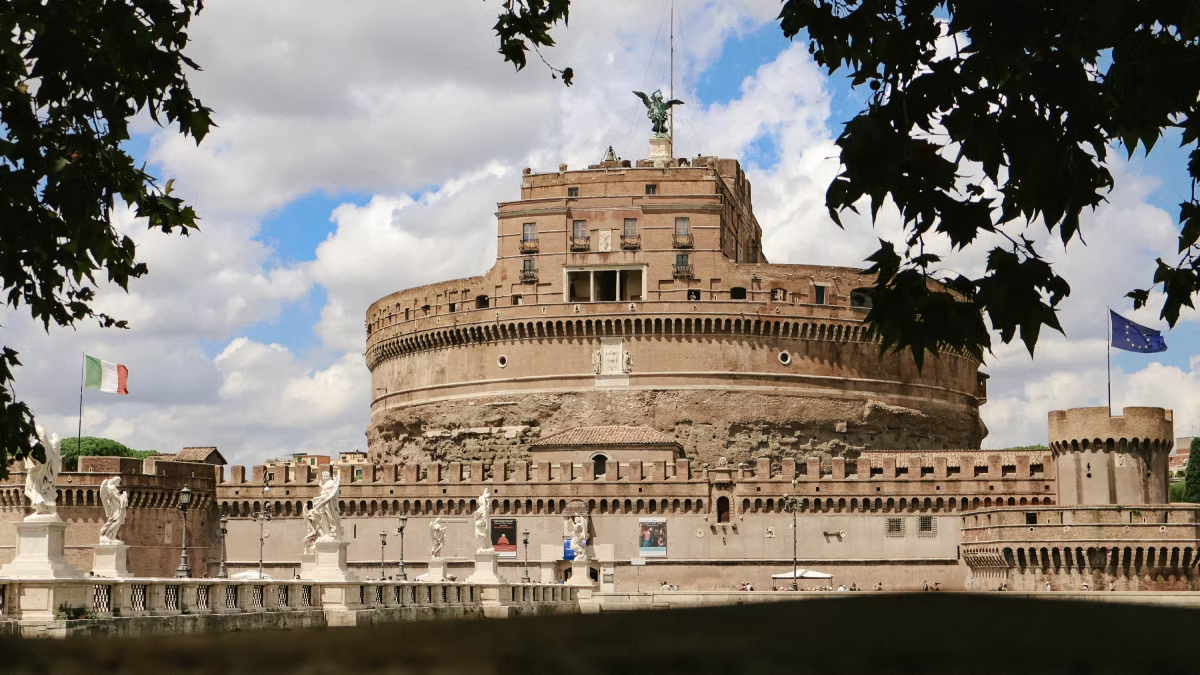
Castel Sant’Angelo began as Hadrian’s Mausoleum, built AD c.135–139 as an imperial tomb, and was later absorbed into Rome’s Aurelian Walls as a fortress. From the Middle Ages it served popes as a stronghold and refuge — most famously during the 1527 Sack of Rome — then as a prison for centuries. Decommissioned as a military site after Italian unification, it opened as a national museum in the early 1900s and remains one of Rome’s most layered monuments.
Few buildings in Rome have changed jobs as many times as Castel Sant’Angelo. In roughly 1,900 years it has been an emperor’s tomb, a river fortress, a papal palace, a dungeon, and now a museum — and the physical building still carries the scars and additions of every stage. Walking through it today means walking through nearly two millennia of Roman history in a single visit.
This guide follows that history in order, from Hadrian’s original mausoleum to the national museum you can visit now, with the popes, sieges, and transformations that shaped it along the way.
AD 135–139: Hadrian’s Mausoleum
Emperor Hadrian commissioned the building as his own tomb around AD 135, and it was completed and consecrated in AD 139 after his death, under his successor Antoninus Pius. It stood on the right bank of the Tiber, connected to the city by a new bridge, and was built as a massive cylindrical drum on a square base, faced in marble and capped with a garden and statuary.
Hadrian, who ruled the Roman Empire from AD 117 to 138, wanted a tomb grander than Augustus’s mausoleum across the river, which was by then nearly full. He chose a site outside the city walls on the Tiber’s right bank and built a new bridge, Pons Aelius, to carry a formal funerary approach to it — the structure known today as Ponte Sant’Angelo. The mausoleum itself was a squat square base topped by a huge cylindrical drum, originally faced in travertine and Parian marble and crowned with a mound of earth, cypress trees, and a bronze statue, likely of Hadrian himself driving a chariot.
Hadrian died in AD 138, a year before the building was finished, and it was completed and dedicated in AD 139 by his adopted successor, Antoninus Pius. At its core, cut into the drum, was a spiral ramp leading to a central burial chamber — the same helical ramp visitors still climb today, one of the best-preserved pieces of the original Roman structure.
The Imperial Tombs: Hadrian to Caracalla
The mausoleum did the job it was built for through most of the 2nd and early 3rd centuries. Hadrian’s ashes were placed there, followed over the following decades by his wife Sabina, his adopted heir Lucius Aelius, and the emperors who succeeded him in the Antonine and Severan lines. The last emperor confirmed to have been interred in the mausoleum was Caracalla, who died in AD 217 — nearly eighty years after the building’s completion. After Caracalla, the tomb stopped receiving imperial burials, and its role as a mausoleum effectively ended, even though the building itself remained standing and increasingly useful for other purposes.
3rd Century: Absorbed into the Aurelian Walls
In the AD 270s, Emperor Aurelian built a new defensive circuit around Rome, and the mausoleum’s massive scale and riverside position made it a natural point to fortify. It was incorporated into the city’s defenses and began its long second life as a military stronghold rather than a tomb.
By the late 3rd century, Rome faced growing pressure from external threats, and Emperor Aurelian responded by building the Aurelian Walls, a defensive circuit around the whole city completed around AD 275. Hadrian’s Mausoleum sat just outside the earlier boundary but close enough to the river crossing that it made strategic sense to fold it into the new fortifications. Its thick masonry core and height gave defenders an obvious advantage, and from this point the building’s identity shifted permanently from funerary monument to fortress. This is the turning point that set the course for the next sixteen centuries: a tomb built for one emperor became a piece of military infrastructure that would outlast the empire itself.
590 AD: The St. Michael Legend and the New Name
According to tradition, in AD 590, during a devastating plague in Rome, Pope Gregory the Great saw a vision of the Archangel Michael atop the fortress, sheathing his sword to signal the plague’s end. The building became known from that point as “Castle of the Holy Angel” — Castel Sant’Angelo — and the name has stuck ever since.
The legend is one of the most enduring stories attached to the monument. Rome was in the grip of an epidemic, and Pope Gregory the Great led a penitential procession through the city. As it passed the old mausoleum, he is said to have seen the Archangel Michael appear above it, sheathing a sword as a sign that the plague was ending. Whether or not the vision happened exactly as told, the story gave the fortress its lasting name and its most recognizable symbol. A marble angel was later placed in a courtyard to commemorate the event, and centuries afterward a bronze statue of Saint Michael, cast in the 18th century by Peter Anton von Verschaffelt, was raised on the summit, where it still stands watch over the city.
The Middle Ages: A Papal Stronghold and the Passetto
Through the early medieval centuries, control of the fortress passed between popes, Roman noble families, and occasionally invading forces, reflecting the turbulence of the era. By the 13th century the papacy had secured it firmly as part of its own defenses, recognizing that whoever held the fortress by the Tiber held a critical piece of the city’s security and a direct line to the Vatican across the river.
That link became physical in 1277, when Pope Nicholas III ordered the construction of the Passetto di Borgo, an elevated fortified corridor roughly 800 meters long connecting the Vatican Palace directly to the castle walls. The Passetto meant a pope under threat could move from St. Peter’s to the safety of the fortress without ever setting foot on an open street — a piece of medieval engineering that would prove decisive nearly 250 years later.
The Renaissance: Papal Refuge and the 1527 Sack of Rome
During the Sack of Rome in 1527, Pope Clement VII fled the Vatican for Castel Sant’Angelo via the Passetto di Borgo as mutinous troops of Charles V overran the city, and the fortress sheltered him and members of his court for months while Rome was pillaged outside its walls. The event cemented the castle’s reputation as the papacy’s last line of defense.
The Renaissance popes turned the fortress into both a stronger military asset and a more comfortable one, adding bastions at the corners and beginning to fit out livable rooms within the ancient core. That investment paid off dramatically in May 1527, when the unpaid, mutinous army of Holy Roman Emperor Charles V stormed Rome in one of the most violent sacks in the city’s history. Pope Clement VII escaped along the Passetto from the Vatican just ahead of the invaders and held out inside Castel Sant’Angelo for months while the city below was looted and its population terrorized. The siege is the single event most associated with the castle’s role as a papal refuge, and it left a lasting mark on how the fortress was subsequently built up and defended.
In the decades that followed, particularly under Pope Paul III of the Farnese family, the castle’s interior was further transformed with genuinely elegant living quarters. These papal apartments include the Sala Paolina, with its frescoed ceilings, and rooms decorated with mythological scenes such as the Amore e Psiche and Perseus rooms — a striking contrast between the building’s military exterior and its refined interior, and a reminder that the fortress was as much a residence as a stronghold in this period.
Centuries as a Prison
Alongside its role as a papal residence and fortress, Castel Sant’Angelo also served for centuries as a state prison, holding both common criminals and, at times, prominent political and religious prisoners. The lower levels and converted chambers held cells that were often damp, cramped, and cut off from daylight, a sharp contrast to the frescoed apartments above. The building’s dual identity as both palace and prison lasted well into the 19th century, and the cells and their most notable prisoners are still visible on a visit today, alongside the armory and storerooms that supported the fortress’s long military life.
Italian Unification and the End of Military Use
The castle’s status changed fundamentally with Italian unification in the 19th century. As Rome became the capital of a unified Italy in 1870 and papal temporal power ended, Castel Sant’Angelo passed out of Church control and into the hands of the new Italian state. Its centuries-old function as an active military fortress and prison was gradually wound down, a shift that mirrored the broader transformation of Rome from a papal capital into the seat of a modern secular government.
1901 and 1906: Opening as a National Museum
After its military role ended, Castel Sant’Angelo was restored and opened to the public as a national museum in the early 20th century, with sources generally citing 1901 and 1906 as key dates in that transition. It has operated as the Museo Nazionale di Castel Sant’Angelo ever since, displaying its own architecture and history alongside collections of arms, ceramics, and Renaissance-era furnishings.
Freed from its military function, the fortress underwent restoration work aimed at stabilizing the ancient core and making its long history legible to visitors rather than hidden behind centuries of defensive additions. It opened progressively as a public museum in the early 1900s, and by the early 20th century it was formally established as the Museo Nazionale di Castel Sant’Angelo, a role the Italian state has maintained continuously since. The museum’s collections grew to include historic weaponry, ceramics, and period furnishings, displayed within the same rooms — from the ancient ramp to the Renaissance apartments — that had witnessed the building’s earlier lives.
Castel Sant’Angelo Today
Today the castle is one of Rome’s most visited monuments, and its appeal rests directly on this layered history: visitors climb Hadrian’s original spiral ramp, walk through Renaissance papal apartments, pass former prison cells, and finish on the rooftop Terrace of the Angel beneath the bronze statue of Saint Michael, with one of the best panoramic views over Rome and St. Peter’s. The building’s association with Puccini’s opera Tosca, whose final act is set on these ramparts, adds a further cultural layer to an already dense one. For a full sense of what the different levels contain, our floor-by-floor walkthrough covers the museum as it exists now, room by room.
Frequently Asked Questions
When was Castel Sant’Angelo built?
Construction began around AD 135 under Emperor Hadrian as his personal mausoleum, and the building was completed and dedicated in AD 139, a year after Hadrian’s death, under his successor Antoninus Pius. That makes the core structure nearly 1,900 years old.
Who was Castel Sant’Angelo originally built for?
It was built as the tomb of Emperor Hadrian and was subsequently used for the ashes of later emperors and their families, including Hadrian’s wife Sabina and his successors through the Antonine and Severan dynasties. The last emperor known to have been buried there was Caracalla, who died in AD 217.
Why is it called Castel Sant’Angelo?
The name comes from a legend dating to AD 590, when Pope Gregory the Great reportedly saw a vision of the Archangel Michael sheathing his sword atop the fortress, signaling the end of a plague in Rome. The building became known as Castel Sant’Angelo, “Castle of the Holy Angel,” and a bronze statue of Saint Michael now stands on its summit.
How did a tomb become a fortress?
In the AD 270s, Emperor Aurelian built a new defensive wall circuit around Rome, and the mausoleum’s massive, thick-walled structure near the Tiber crossing made it a natural point to fortify. It was absorbed into the Aurelian Walls and began functioning as a military stronghold from the 3rd century onward.
What happened at Castel Sant’Angelo during the Sack of Rome?
In 1527, Pope Clement VII fled the Vatican for Castel Sant’Angelo via the Passetto di Borgo as troops loyal to Charles V overran and pillaged the city. He and his court sheltered inside the fortress for months, and the episode became the defining example of the castle’s role as the papacy’s last refuge.
What is the Passetto di Borgo and when was it built?
The Passetto di Borgo is an elevated fortified corridor, roughly 800 meters long, connecting the Vatican Palace directly to Castel Sant’Angelo. It was built in 1277 under Pope Nicholas III specifically so that a pope could reach the fortress safely in an emergency, a purpose it served most famously in 1527.
Was Castel Sant’Angelo ever a prison?
Yes. For several centuries the castle served as a state prison alongside its role as a papal fortress and residence, holding both ordinary criminals and, at times, notable political and religious prisoners in cells within its lower levels. This dual use as both palace and prison lasted into the 19th century.
When did Castel Sant’Angelo become a museum?
After its military role ended following Italian unification, the castle was restored and opened to the public, with 1901 and 1906 generally cited as key dates in its transition to a museum. It has operated since as the Museo Nazionale di Castel Sant’Angelo, Italy’s national museum dedicated to the building and its collections.
What can you still see from each historical period today?
Hadrian’s original spiral ramp and the base of the ancient mausoleum survive from the Roman period; the Passetto and outer bastions reflect the medieval and Renaissance fortress; the Sala Paolina and other frescoed rooms date to the papal apartments; and former cells recall its centuries as a prison. The rooftop terrace and statue of Saint Michael tie the whole history together in a single visit.
Is the history explained on site, or should I know it beforehand?
The museum displays some historical context, but a visit moves quickly through very different eras without always spelling out the connections. Reading up beforehand, or joining a guided tour, helps make sense of how one building went from imperial tomb to papal fortress to prison to museum.
